


You’ve placed the order. The samples passed, the factory is packing, and your forwarder asks one question: “LCL or FCL?”
For a lot of buyers, that’s where it stops making sense. Your goods clearly don’t fill a whole container, so sharing one sounds like the cheaper option. But that’s not always true. Once your cartons pile up, per-cubic-meter LCL charges can quietly overtake the price of booking your own box.
If you’re new to this, the whole topic of LCL shipping from China can feel like a wall of jargon. This article isn’t going to teach you to book vessels or clear customs. It answers one thing only: based on how much space your cargo actually takes, which option costs less.
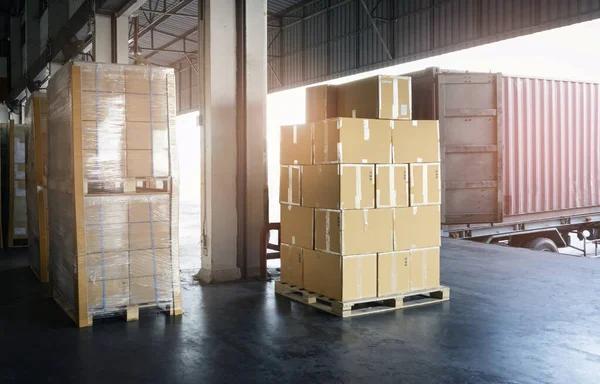
Think of it like this. FCL is chartering the entire bus—you pay for every seat, even the empty ones. LCL is hopping on a shared van, paying for just the spot you take. The shared van sounds cheaper until your luggage starts taking up half the vehicle, at which point you’d have been better off chartering the bus in the first place.
LCL and FCL in one minute
LCL stands for Less than Container Load. Your goods don’t fill a container, so a forwarder groups your cartons with other shippers’ cargo into one shared box. You pay for the space you occupy—usually measured in cubic meters (CBM).
FCL is Full Container Load. One container, one customer. The factory loads it, seals it, and it stays sealed until it reaches your destination. You pay one flat rate for the box, regardless of whether you fill it to 80% or 100%.
That’s the whole difference. The math gets interesting because the two pricing models behave in opposite ways as your volume grows.
How much space is really inside a shipping container
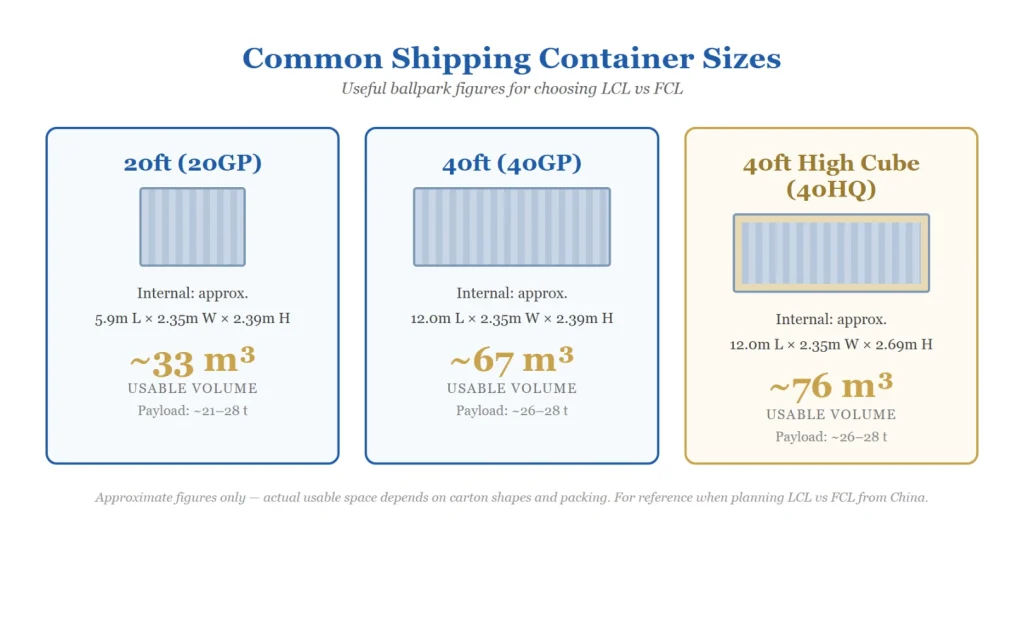
Before you compare anything, you need a rough sense of what you’re comparing. The three boxes you’ll see most often:
- 20ft standard (20GP): about 33 CBM of usable space, payload around 21–28 tonnes.
- 40ft standard (40GP): about 67 CBM.
- 40ft high cube (40HQ): about 76 CBM—taller than a 40GP, the default for most light, bulky cargo.
These are rough internal volumes; exact numbers vary by carrier, and you’ll never pack to the theoretical maximum because of carton shapes and gaps. In practice a 20ft box usually holds around 28 CBM of real cargo—not the theoretical 33. Treat them as ballparks, not engineering specs.
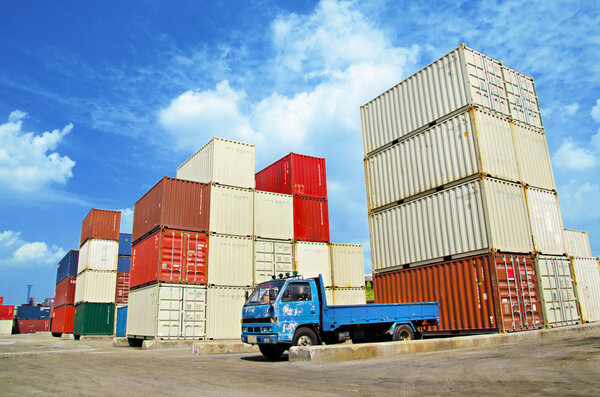
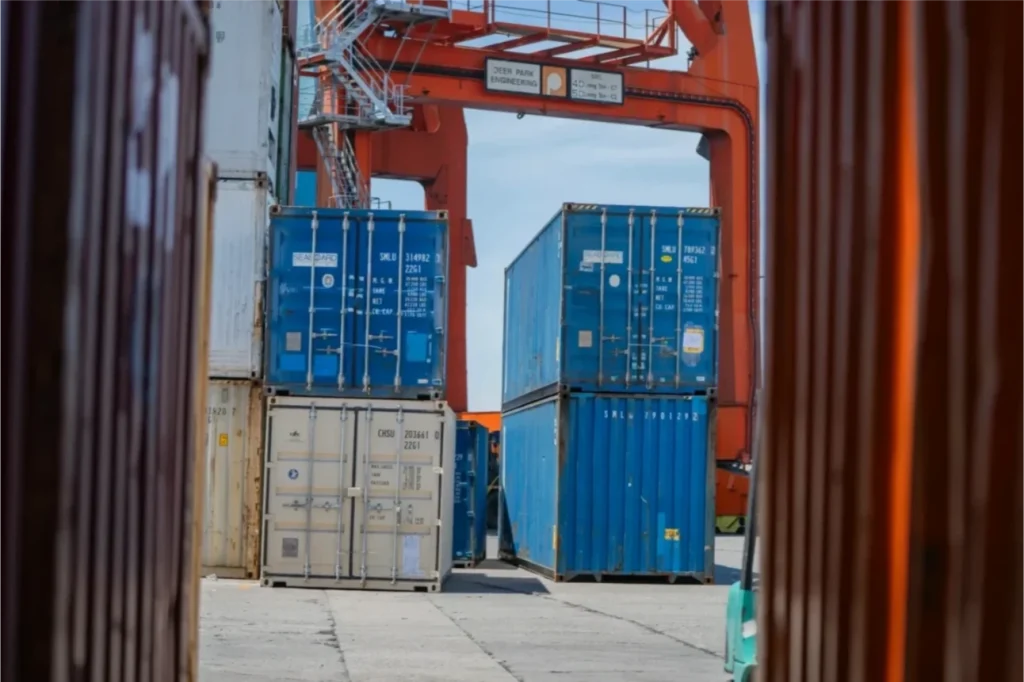
A quick note on the departure side. If your goods come out of the Pearl River Delta, you’re shipping out of one of the most capable port systems on the planet. The Port of Shenzhen handles millions of containers a month—Yantian alone moved over 1.6 million TEUs in August 2026, a single-month record for the port (Yantian Port record). Once your cartons are ready, getting them onto a vessel is rarely the bottleneck.
The first move most buyers skip: calculate your own CBM
You can’t decide LCL versus FCL until you know how many cubic meters your cartons take up. It takes two minutes.
Take one export carton. Multiply its length × width × height in meters. Say a carton measures 0.40m × 0.30m × 0.35m—that’s 0.042 CBM per carton. Multiply by your carton count: 500 cartons × 0.042 = about 21 CBM.
That single number unlocks the rest of this article. Light, bulky products (plastic goods, foam, assembled furniture) balloon in CBM but stay light; dense products (metal parts, glass bottles) weigh more per CBM. Both get priced differently, but CBM is always where you start.
How LCL shipping from China actually charges you
LCL pricing is per unit of space. You pay for every CBM you occupy (or every 1,000 kg, whichever comes out higher—this is the “weight or measure, whichever greater” rule). Most forwarders apply a minimum, commonly around 1 CBM, so even a half-CBM shipment is still billed as a full one.
The rate per CBM swings with the destination, the season and fuel surcharges, so we won’t pin a fixed number on it here—those rates move constantly. What matters is the logic: your cost grows roughly linearly with every carton you add.
That linear growth is exactly what makes LCL shipping from China attractive for small shipments—and dangerous once your order gets bigger.
How FCL charges you
FCL pricing is the opposite. One box, one flat rate. You don’t pay more if you fill it to 70% instead of 100%; the carrier charges for the unit, not the space inside it.
So the cost per CBM inside a 40HQ drops as you pack more in. Half-empty, that box looks expensive. Stack it to the door, and per-CBM it suddenly beats anything LCL can offer.
This is the tension this whole article is about: LCL charges you by the piece, FCL charges you by the box. At some point, per-piece pricing crosses the flat box rate.
The break-even point most forwarders won’t spell out
Industry rule of thumb, consistent across the forwarders we work with:
- Below about 10 CBM: LCL is almost always cheaper.
- Above about 15 CBM: FCL usually wins on total freight.
- Between 10 and 15 CBM: genuinely a toss-up—get quotes for both before you commit.
Why the gap? Because LCL isn’t just “space per CBM.” It also includes consolidation, handling and destination-side fees that don’t scale down. Those fixed costs make small LCL shipments reasonable, but they eat into savings once you’re moving real volume.
Keep the bus analogy in mind. A shared van is a great deal when you have one suitcase. When your luggage fills half the van, per-seat pricing stops making sense—charter the bus.
A real example: 5 CBM, 12 CBM, 20 CBM
Same carton, same destination, three order sizes. LCL is priced per cubic meter—usually tens of dollars per CBM, with rates moving by route and season—so the exact dollar figures shift constantly. What doesn’t change is the shape of the decision, and that’s what matters.
Small order, around 5 CBM. LCL per-CBM charges come out to a small total. Booking a whole 20ft box for five cubic meters of goods is paying for a mostly empty container. Clear choice: LCL.
Middle order, around 12 CBM. Now the LCL per-CBM total is climbing, and a 20ft box isn’t wildly more expensive. The two quotes are close—this is exactly the range where you ask for both and compare line by line.
Bigger order, around 20 CBM. LCL per-CBM charges have stacked up past the flat rate of a 20ft box, and you’ve still got room left inside that box if you load it cleverly. FCL wins, usually by a comfortable margin.
Notice what happened. There’s no permanent “LCL is cheaper” or “FCL is cheaper.” There’s only the point where your CBM crosses over—and that’s why you calculate CBM before you start comparing quotes.
The things that make a “cheap” quote stop being cheap
A few other factors move the total, flagged here only so they don’t surprise you.
Dense cargo. If your goods are heavy per CBM, the “weight or measure” rule can trigger weight-based pricing instead of space.
Speed. LCL moves slower—it has to be consolidated at origin and deconsolidated at destination, which typically adds 5–10 days versus FCL. If you’re chasing a launch date, FCL’s sealed box often wins on transit time.
Destination charges. LCL shipments typically carry more destination-side handling fees than FCL. We’ll do a separate article on those hidden charges later, because they deserve their own treatment.
For now, just know that the headline rate is never the whole bill. If you’re still getting your head around Incoterms and what’s included where, our sea freight from China guide walks through FOB, CIF and DDP in plain language.
What we actually do—and what we don’t
Straight answer first: we are sourcing agents, not a logistics company. We don’t carry cargo, we don’t book vessels, and we don’t run trucks.
Here’s what we do do. When we know your product, your destination and your carton sizes, we help you line up the right forwarders—not necessarily the cheapest ones, but the ones that tend to move cargo without drama. We get comparable quotes from several of them, put them side by side, and point out where one quote is quietly more expensive or where a fee has been left out.
If you’d rather go DDP—delivered, duty paid, door to door—we help you sort out what’s actually included, the import duties involved, and the last-mile delivery range, so the DDP number doesn’t turn into a surprise later.
You don’t have to negotiate with five forwarders on your own, and you don’t get locked into one quote just because it arrived first. The cargo still moves through a real logistics company. We’re the ones making sure that company is a good bet, and that the quote you sign is the one you actually pay.
If you want to understand the broader choice between sea, air and express first, our guide to shipping from China covers costs, transit time and how shipments get delayed.
FAQ
What’s the minimum I can ship LCL?
Most forwarders charge from 1 CBM as a minimum, so even a half-CBM shipment is billed as a full one. For very small orders, air or express often wins anyway.
How many cubic meters before I should switch to FCL?
As a rough rule, below 10 CBM LCL is usually cheaper; above 15 CBM FCL usually wins; in between, get both quotes.
Why do DDP quotes vary so much between forwarders?
Because “DDP” can mean different things: some quotes include duties and last-mile delivery, others leave destination fees or import taxes out. That’s exactly why comparing them line by line matters.
Do you actually ship the cargo yourselves?
No. We’re sourcing agents. We recommend reliable logistics partners, help you compare quotes, and assist with DDP arrangements. The shipping itself is handled by a professional freight forwarder.
What information do you need from me to help? Your product, the destination country, your carton dimensions, your quantity, and whether you want door-to-door delivery. That’s enough to start lining up the right options.
Send us your product, your destination, your carton size and your order quantity. We’ll help you compare LCL versus FCL, shortlist the right forwarders, and sort out DDP if you want it delivered to your door. If you want to walk through your cargo details before booking a forwarder, speak to our team for a free consultation and we will review your shipping options with you.
More on shipping and customs
- Customs clearance from China — the four gates and the ten days that decide your bill
- Shipping from China — costs, transit times and the fees nobody quotes
- Sea freight from China — FOB, CIF and DDP compared, plus the hidden charges
Also worth reading: Pearl River Delta vs Yangtze River Delta — which region fits your product category and budget.