


QC & inspección
Inspección AQL explicada: ¿cuántas unidades deberías revisar realmente?
Let me start with a moment almost every new buyer has been through.
You order 1,000 units from China. Your inspection company writes back and says: “We’ll run an AQL inspection and pull 80 pieces.”
And you pause. 80 out of 1,000? Is that really enough? What if the other 920 are all bad and you just got unlucky?
A lot of buyers react the same way: “Then just check every single unit. 100% inspection, problem solved.”
Sounds great in theory. But it’s like proofreading a 500-page document word by word. By page 300, your eyes are glazing over, and obvious mistakes sail straight past you. Full inspection is slow and expensive, and once an inspector gets tired, the defect rate they actually catch starts to drop.
Then there’s the other approach. The factory sends over three or five samples, everything looks perfect, and you relax. But judging a whole shipment from the samples the factory hands you is like judging a restaurant from one carefully staged photo on Instagram. The container arrives, you open it, and what’s inside has nothing to do with the picture.
So what’s the answer?
There’s already a mature, industry-standard way to handle this: AQL. Ask any third-party inspection company working in China — SGS, BV, TÜV — and they’ll tell you this is the system they use for almost every shipment. It’s the same idea behind a blood test: a doctor doesn’t drain every drop to check your health. One vial, drawn correctly, says a lot about the whole body. AQL works the same way. Check the right small sample, pulled the right way, and you can make a confident call about the entire order.
Let’s walk through it plainly: how many units to pull, how to check them, and how many defects are too many. No math degree required.
What Exactly Is AQL?
AQL stands for Acceptable Quality Limit.
If the name sounds abstract, here’s a simple way to hold it in your head: think of it as a passing score on an exam. Score at or above the line, and the batch passes. Score clearly below it, and the batch gets sent back. At an AQL of 2.5, a batch with a defect rate around 2.5% is likely to pass; a batch running noticeably worse is very likely to be rejected.
But there’s one misunderstanding I need to clear up right away, because it trips up almost everyone.
An AQL of 2.5 does NOT mean 2.5% of your order is “allowed” to be defective. It is not permission for the factory to build 2.5% junk.
AQL is a safety net, not a guarantee. A net catches the really bad falls; it doesn’t promise you’ll never stumble. AQL can’t promise zero defects in a passed shipment. What it does — very reliably — is catch batches that are genuinely bad before they ship.
Hold onto that distinction, and a factory can never wave it away with “but AQL allows 2.5%, right?”
Three Terms, and You’ve Got the Basics
AQL tables look like a wall of numbers at first glance. Strip them down, and there are really just three ideas.
1. Lot Size
This is simply the total number of units in the batch. Order 1,000 pieces, and your lot size is 1,000.
2. Sample Size
This is the number of units actually pulled and inspected. The word that matters here is random.
Think of a pollster predicting an election. They don’t ask every single voter — they interview a carefully spread, random sample, and that sample tells them how the whole population leans. If they only phoned people in one wealthy neighborhood, the result would be useless. Same here. The inspector pulls from different cartons and different positions in the shipment. The factory doesn’t get to hand over its favorite box.
3. Acceptance and Rejection Numbers (Ac / Re)
This is the part that actually decides things.
- Ac (Acceptance number): defects at or below this number, and the batch passes.
- Re (Rejection number): defects at or above this number, and the batch fails.
Think of it like the cutoff score on a driving test. Miss this many or fewer, you’re licensed. Miss one more, and you’re back next month.
Where do these numbers come from? Two tables. We’ll read them together step by step in a moment.
Which Inspection Level Should You Use?
AQL splits into two families of levels.
General Inspection Levels: I, II, and III
The difference is simple: each level pulls a different number of units, and each is a different level of strictness.
Picture the three lanes at airport security:
- Level I is the trusted-traveler lane — smallest sample, lightest check, lowest cost. It’s for factories you’ve worked with for years, whose quality is rock solid, or for low-value goods where a minor flaw doesn’t hurt much.
- Level II is the standard lane. It’s the default for almost every consumer product, and it’s what inspection companies use unless told otherwise. If you’re unsure, take Level II. You’ll be right the vast majority of the time.
- Level III is the secondary screening — belt off, bag emptied, every pocket turned out. Largest sample, strictest review. Use it for new factories, high-value products, suppliers who have burned you before, or clients who are unusually demanding.
To make it concrete, take a 3,000-unit order: Level I pulls roughly 80 pieces, Level II around 200, and Level III up to 315 — nearly four times the work.
Special Inspection Levels: S-1 through S-4
These use tiny samples and exist mainly for destructive testing. Think pull tests, drop tests, lifespan tests — where the product is destroyed in the process. You’re not going to sacrifice a few hundred units to find out if they survive a fall, so you test a handful. Most buyers never need these; just know they exist.
Not All Defects Are Created Equal
One of the smartest parts of AQL is that it doesn’t dump every problem into one bucket. Defects are sorted into three categories, and each category is counted and judged separately.
It’s a lot like triage at a hospital. A heart attack, a sprained ankle, and a common cold don’t get the same response, and neither do your defects.
1. Critical Defects — usually AQL 0
These are the problems that could hurt someone, break the law, or make the product unusable.
Examples: an electrical product that could shock the user, a sharp exposed edge on a children’s toy, non-compliant food-contact material, or a missing mandatory mark like the CE logo.
This is the red-flag category, and the rule is zero tolerance. Find a single critical defect in the sample and the entire batch is rejected — no need to count anything else.
2. Major Defects — usually AQL 2.5
Not safety issues, but problems that clearly affect function or saleability.
Examples: the unit won’t turn on, dimensions are well out of tolerance, a feature doesn’t work, there’s a structural problem, or a key component is missing.
The industry default is AQL 2.5. For high-end goods — premium electronics, for example — buyers often tighten to 1.5 or even 1.0.
3. Minor Defects — usually AQL 4.0
These don’t affect use at all. They’re purely cosmetic.
Examples: a faint surface scratch, a small spot, a loose thread on apparel, a very slight color variation, a lightly creased box.
The default is AQL 4.0. Think of it as a wrinkle on your shirt before work — you’re still perfectly functional.
Here’s where I want to press on you a little: never leave the definitions until the day of inspection.
Decide in advance what counts as major versus minor, write it into your inspection checklist, and get the factory to confirm. Otherwise the inspector calls it “a major defect that makes the unit unsellable” while the factory shrugs and calls it “a small mark,” and you’re caught in the middle of an argument you can’t win.
How to Read the Two Tables
Enough theory. Here’s the practical part. AQL uses two tables in sequence.
Table 1: lot size + inspection level → a code letter
- Find your order quantity’s range in the left column.
- Find your chosen level across the top (default: Level II).
- The cell where they meet gives you a code letter from A to Q.
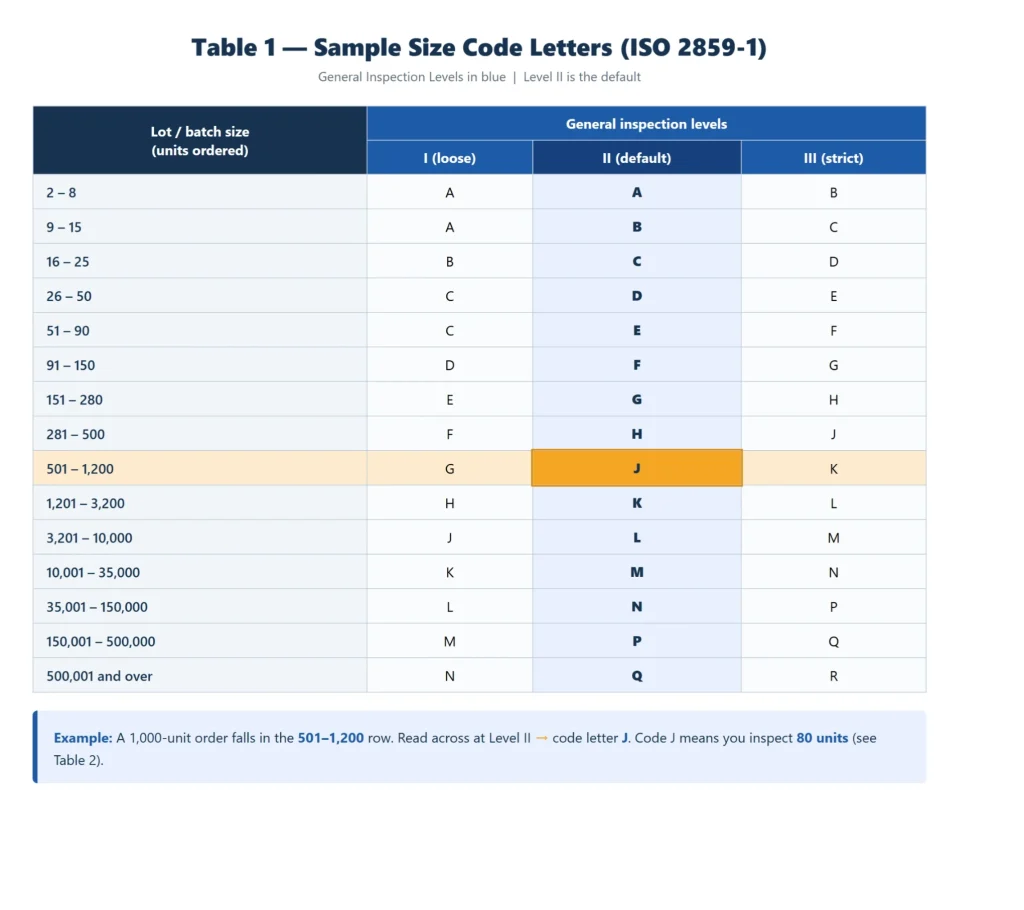
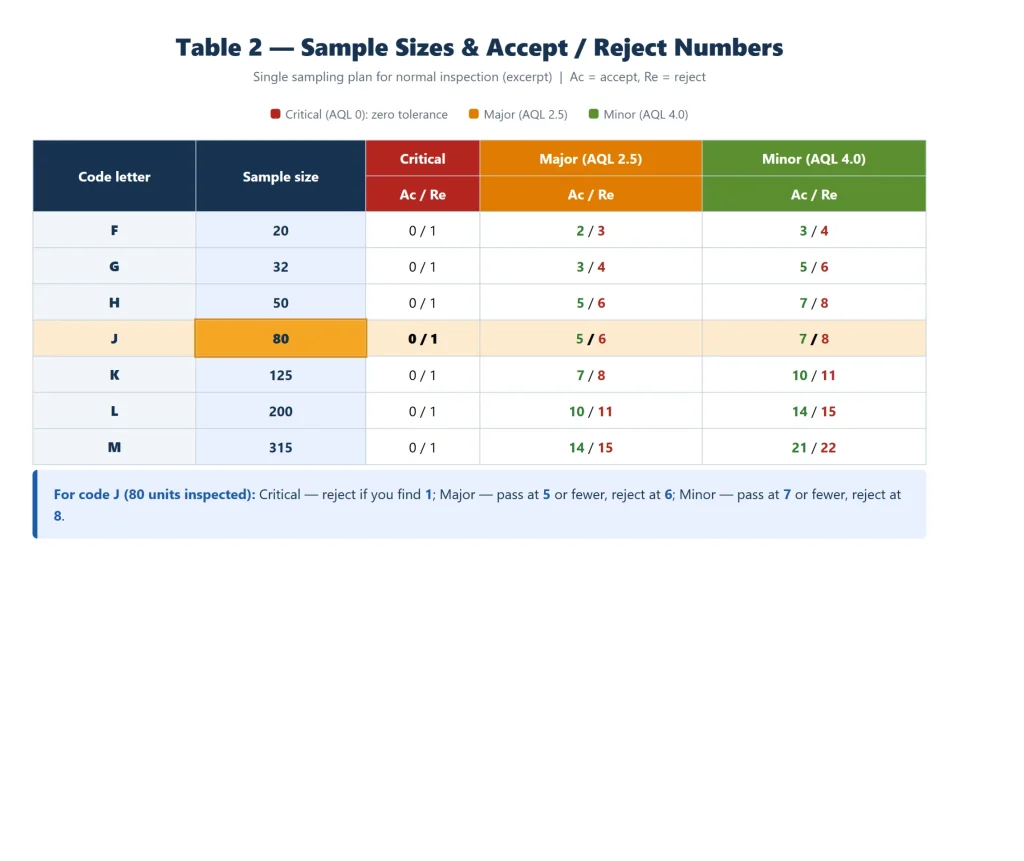
Table 2: code letter + AQL value → sample size and Ac/Re
- Find your code letter, which points to a sample size.
- Find the AQL value you set across the top (2.5, 4.0, and so on).
- The cell where they meet gives you the Ac and Re numbers.
It works like a two-step lookup on a GPS. The first table gets you to the right zip code; the second takes you from the zip code to the exact house number — your sample size and your pass/fail line.
One spot trips up every beginner: some cells contain an arrow instead of numbers. Don’t panic. Follow the arrow to the first cell that has numbers, and use that row’s sample size and acceptance figures.
Telling isn’t enough, so let’s run a real order through it end to end.
Worked Example: A 1,000-Unit Order
Say you’ve ordered 1,000 small home appliances from a factory in the Pearl River Delta. You’re using the standard Level II, with the usual criteria: Critical 0 / Major 2.5 / Minor 4.0.
Step 1: Find the code letter
A lot of 1,000 falls in the 501–1,200 range. Across at Level II, that’s code letter J. Code J corresponds to a sample size of 80 units.
That’s where the inspector’s “80 pieces” comes from — not a guess, a table.
Step 2: Randomly pull 80 units
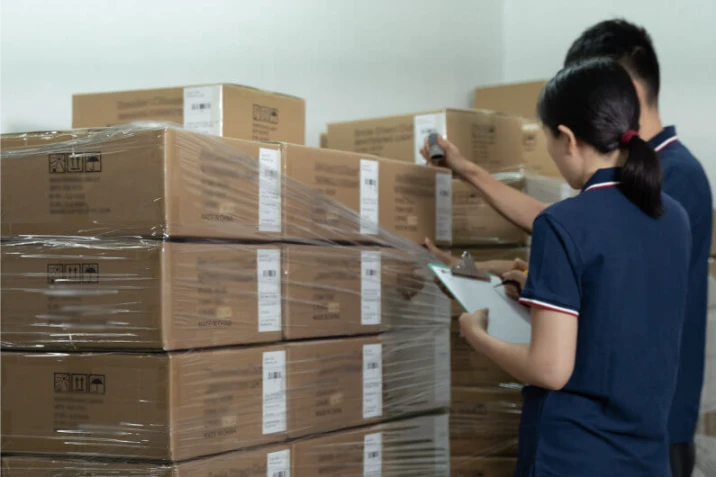
The inspector draws 80 units from different cartons throughout the shipment. The factory doesn’t get to choose which cartons are opened.
Step 3: Count by category and judge
- Critical defects (AQL 0): find one, reject on the spot. No exceptions.
- Major defects (AQL 2.5): at 80 units, Ac = 5 and Re = 6. In plain language, five or fewer major defects pass; six or more reject.
- Minor defects (AQL 4.0): at 80 units, Ac = 7 and Re = 8. Seven or fewer pass; eight or more reject.
Now let’s play out a few outcomes:
- The inspector finds 0 critical, 4 major, and 6 minor. Major is 4 ≤ 5 and minor is 6 ≤ 7, so nothing crosses the line. The batch passes and can ship.
- Next order: 0 critical, 6 major, and 3 minor. Major hits 6, which is at Re, so the batch is rejected — even though minor defects are well under the limit. Cross the line in any one category and that’s it.
- Then: 1 critical defect, say an electrical shock risk. Don’t bother counting the rest. Rejected immediately.
Picture three separate gates at one entrance. The shipment has to pass through all three; get turned away at any one of them, and it doesn’t leave.
When to Tighten, and When to Loosen
Tighten up — move to Level III, or lower the AQL values — in these situations:
- A brand-new factory you haven’t had time to read yet.
- A supplier whose previous shipment had quality problems.
- Expensive products, or anything safety-related — electrical goods, children’s products, medical items.
- A major brand or a client with demanding standards.
- A rushed order. In my experience, the jobs that get squeezed for time are the ones that come back to bite you.
The logic here is exactly how a bank treats risk. A brand-new borrower with no credit history goes through strict underwriting; a 20-year customer who’s never missed a payment gets a looser leash.
You can loosen it in these cases:
- A long-term factory with a consistently clean quality record.
- Low-value, low-risk products.
- Extremely simple products where there’s very little to go wrong.
AQL itself actually has a formal tightening-and-loosening system built in — several consecutive clean batches allow reduced inspection, and consecutive failures trigger tightened inspection. For most buyers, though, judging it by the rules of thumb above is more than enough.
Five Common Mistakes to Avoid
Mistake 1: “AQL 2.5 means 2.5% defects are allowed.”
No. It’s a decision threshold, not a defect allowance for the factory.
Mistake 2: “Let the factory decide how many to check and which boxes.”
The sample size comes from the table, and the sample must be random. The units a factory voluntarily holds up to you? They’ve been chosen for a reason.
Mistake 3: “Full inspection must be safer than sampling.”
Remember the 500-page proofreading problem. Full inspection costs more, takes longer, and at high volume the inspector gets tired and misses more. For most consumer goods, AQL sampling is simply the better-value option.
Mistake 4: “If I use AQL, I won’t receive a single defect.”
Don’t think that way. AQL is a probability tool, not a zero-defect guarantee. A clean annual physical doesn’t promise you’ll never catch a cold; it means there’s no sign of anything serious. AQL stops genuinely bad batches, but a passed shipment can still contain a few isolated defects.
Mistake 5: “The inspector can just decide major versus minor on the day.”
That’s how disputes happen. Agree on the definitions before the order and put them in the checklist.
More on quality inspection
- AQL sampling in China — how many pieces to inspect for your order size
- Pre-shipment inspection — what we check before your balance payment leaves
- During production inspection — catching defects at 30%, 50% and 80% through the run
Also worth reading: Checking a Chinese business licence — five steps to verify a licence before you pay.
How We Run AQL Inspection on the Ground
When we inspect for buyers across the Pearl River Delta, our default is General Level II with Critical 0 / Major 2.5 / Minor 4.0, adjusted to the product:
- Electrical goods, children’s products, and food-contact items: zero tolerance on critical, and we often tighten major as well.
- Clients who supply their own checklist: we follow their criteria exactly.
- Long-standing, stable factories: we can loosen appropriately.
In practice, after production is finished and before the container is loaded, our inspector arrives at the factory, pulls a random sample, checks item by item, and photographs everything. You get a detailed report the same day, clearly marking the batch pass or fail, with the defect count in each category.
The value of catching problems at this stage is hard to overstate. It’s like a home inspection finding a leak before you close on the house, while the plumbing is still exposed and cheap to fix — versus discovering it after you’ve moved in, hung the pictures, and bought the furniture. Fix it on the factory floor, where rework and replacement are still easy. Handle it after the goods reach your warehouse, and every option is painful.
For where inspection sits in the whole sourcing process and the exact steps it follows, I’ve written a full walkthrough that pairs with this one — read it alongside this guide and quality control will stop being a blind spot: our pre-shipment inspection checklist covers every stage.
Preguntas frecuentes
My order is small — say 100 units. Does AQL still apply?
It does. Smaller lots just mean smaller samples. 100 units falls in the 91–150 range, which is code F at Level II, so you pull 20. For genuinely tiny orders of a few dozen units, checking everything may simply be the more sensible route — use your judgment.
Is inspection pricing based on the number of units checked?
It’s usually quoted per man-day, not per piece. But the relationship is worth knowing: more units and more complex products mean more hours on site, which can push the cost up.
What if the batch fails AQL and the factory refuses to rework it?
This is exactly why you set the inspection standard and the consequences of failure — rework, replacement, discount, or rejection — in the contract and the PI before anything is built. Settle the rules upfront, and you have something to stand on.
Why do two inspection companies pull different sample sizes for the same product?
Most often they’ve chosen different levels, or one is using a special level. When you book, specify it in one line — “General Level II, Critical 0 / Major 2.5 / Minor 4.0” — and you’ll get consistent results.
Can video or live-stream inspections still use AQL?
The sampling logic carries over, but judging finish, feel, and function through a screen simply isn’t as reliable as standing on the floor. For high-value or high-risk goods, having someone physically there is money well spent.
Final Thoughts
AQL sounds like a wall of jargon, but the whole thing boils down to three moves: find the sample size from your lot size and level, count defects in three separate categories, and compare against Ac/Re for the verdict.
Get comfortable with it, and you suddenly share a common language with factories and inspectors alike. No one can fob you off with “we’ll check it carefully, don’t worry.” Ask which level they use and what the Ac/Re numbers are — and you’ll find out in one sentence whether you’re talking to a professional.
At the end of the day, inspection isn’t there to make anyone’s life difficult. It’s there to put a floor under your risk. You’ve already spent the shipping, the duties, and the time to bring products halfway around the world. This isn’t the place to get casual. Sample smart, fix problems while they’re still at the factory, and you can wait for that container to arrive with peace of mind.
If you’re sourcing from China and want a proper AQL inspection before your goods ship — or you’re just unsure which level and standards fit your product — tell us what you’re making and the quantities involved, and we’ll help you set the right inspection level and defect criteria. If you’re new to the whole process, our complete guide on how to source products from China takes you through it from the first step. If you’d like to know exactly what an on-site inspection covers, book a free inspection consultation with our team and we will walk you through our inspection process.