


Consejos de compra
Cómo verificar la licencia comercial de una empresa china (antes de enviar el depósito)
If you want to check a Chinese company’s business license before sending a deposit, this guide walks you through the exact steps our team runs for every buyer. Most buyers don’t get scammed by obvious fraudsters — they get scammed by companies that look real on paper, with a polished website, fast replies, and a license that appears to match the story. The license is the first document you should ask for, but it is also one of the easiest documents to copy, blur, or pass off under a similar company name.
A license proves that an entity exists and is registered. It does not prove that the company owns a factory, has stable production capacity, keeps its promises on delivery time, or can stand behind product quality after the sale. Many new buyers treat the license as a guarantee; experienced buyers treat it as the starting point of a background check.
We’ve watched buyers wire 30% deposits to suppliers who turned out to be three people working from a rented office. One “8-year Gold Supplier” we checked was a trading company with no factory at all. The license looked perfect. The story behind it didn’t. In both cases, a short background check before payment would have exposed the mismatch early, before any money moved.
The good news: checking a Chinese company’s business license takes about ten minutes and relies mostly on public databases any buyer can access. You do not need a specialist account or a paid subscription to run the basic checks covered here. Below is the step-by-step process we use ourselves, from reading the license itself to verifying the people behind it.
Why You Must Check a Chinese Company’s Business License Before You Pay
Most buyers lose money not to obvious fraud, but to companies that look legitimate on paper. Once a deposit leaves your account, a trading company posing as a factory can become hard to reach, and the agreements you signed rarely give you a quick refund route. Reaching that stage after payment is far harder than running a few checks before you wire anything.
That is why checking the license before you pay anything is the cheapest risk control step you can take. It saves you from the far larger cost of a failed order, a disputed deposit, or a supplier you later have to replace. A few checks before wiring money can protect a deposit that is often 30% of the order value.
Buyers often skip this step because platform badges, quick chats, and sample photos feel like enough proof. Those signals do not answer the core question: is this company a real, registered business that can handle your order? A license check is the first layer that answers that question.
Step 1: Look at the License Itself First
When a supplier sends you their business license, don’t just save the file. Read it. Most license documents share four key fields, and you should check each one before moving to any online database.
Company name: make sure the name matches the company you’re dealing with — not a similar one with one extra word. Scammers sometimes register a name one letter or character away from a well-known brand, so compare the full name carefully against the license rather than trusting the sales contact’s nickname or platform display name.
Unified Social Credit Code: this is the company’s national ID number, 18 characters long. Write it down; you’ll need it for every check below. The code follows a fixed 18-digit structure. The first digit identifies the registering authority. The second identifies the organization type. Digits 3 through 8 are the administrative region code of the registering authority. Digits 9 through 17 are the entity identification number, and the last digit is a check digit. For a regular enterprise registered with the market regulator, the first two digits read 91: 9 means the market regulator and 1 means an enterprise.
Digits 3 through 8 point to the province and city where the company was registered. Reading these positions lets you confirm where the company is registered and what type of entity it is.
Legal representative: the person whose name appears here is legally responsible for the company. Note this name; you will check it again on the enforcement blacklist later, because some companies run up debts under the business name while the responsible person appears on public enforcement records.
Business scope: this tells you what the company is actually allowed to sell and produce. A “trading company” license with “import and export” is fine for a sourcing intermediary, but if the scope says nothing about manufacturing, processing, or production, they are not a factory, whatever their salesperson says. If they claim to make electronics but the scope only lists sales and trade, that gap should raise a question mark before you share drawings or confirm pricing.
Also check the registration date. A brand-new license is not a crime, but a company registered three months ago that claims ten years of factory experience is already lying to you. Newer companies can be legitimate, but they deserve extra verification rather than the same trust you would place in a long-established manufacturer.
Pay attention to the difference between registered capital and paid-in capital. Under China’s subscription system, a company can declare a high registered capital without funding it all at once, so a large registered capital figure does not by itself mean a large factory or deep balance sheet. Paid-in capital, together with annual reports and shareholder changes, gives a more honest picture of real investment and capacity. When the numbers look suspicious, ask the supplier for supporting documents before moving forward, rather than judging the supplier by the number printed on the license alone.
Step 2: Run the Official Government Check
Go to the National Enterprise Credit Information Publicity System (国家企业信用信息公示系统) at gsxt.gov.cn. This is the official government database, run by SAMR (the State Administration for Market Regulation), and it records the registration information filed directly with the authorities. When you check a Chinese company’s business license against this official record, the status you see here is the registration baseline that other platforms build on.
Enter the company name or the Unified Social Credit Code. You’ll get:
- Registration status (registered, canceled, or revoked)
- Registered capital and paid-in details
- The legal representative’s name
- Business scope
- Annual reports
- Administrative penalties, if any
If the system shows “canceled” or “revoked,” walk away. A canceled or revoked company no longer has valid registration, and wiring money to it means paying into a business that the authorities have already removed from active trade. If the annual reports stop years ago, ask why; a company that stopped reporting may be struggling, unorganized, or hiding something from the public record.
The site can be slow from overseas. Be patient, or ask the supplier to send you a screenshot of the system page showing their company — a real supplier can do this in five minutes. If they resist sharing the official system result, treat that hesitation as a signal worth investigating further.
Step 3: Cross-check with Qichacha or Tianyancha
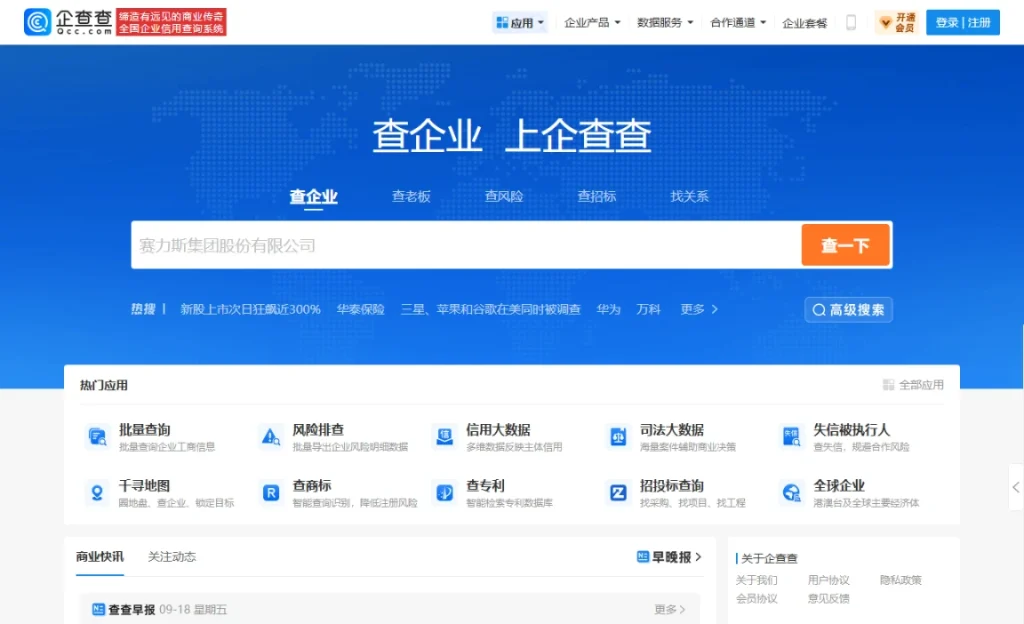
The official system tells you the company exists. It doesn’t tell you the whole story. This is where Qichacha (企查查) and Tianyancha (天眼查) come in — they’re private data platforms that compile court records, shareholder history, related companies, and administrative records from multiple public sources into one searchable page.
Type the company name in and look for the following signals before you move on:
Shareholder and legal representative history: has the legal representative changed often? Companies that change owners or legal representatives every year are often avoiding responsibility or hiding a troubled history. Frequent shareholder shifts can also mean the original owners walked away after problems other buyers did not see.
Related companies: the same owner may have registered several companies — including a closed or suspended one. A supplier that repeatedly closes and re-registers under a new name is a red flag: when one company goes bankrupt or accumulates complaints, they shut it and open the same business again, leaving older disputes behind.
Former names: if the company changed its name recently, search the previous name too. A name change sometimes happens to rebuild trust after lawsuits, unpaid debts, or poor reviews that buyers would otherwise find quickly.
Branches and registration links: a real manufacturer often operates a main business license with one or more branches; a trading company may show several loosely related registrations with no production address behind them. Compare the listed addresses with the factory address the supplier gave you in chats or on the quotation.
Operating anomalies and financial records: watch for entries marked as operating abnormally, unpaid debts, mortgage records, or pledged equity. These entries do not prove the company is unsafe, but they are facts worth asking about rather than ignoring.
Court records and litigation: look for unpaid debts, contract disputes, enforcement actions, or repeated claims against the company. Multiple recent lawsuits over product quality or delivery timelines suggest the supplier struggles to keep commitments.
You don’t need a paid account for the basics. The basic version already shows the core risk signals, and the entry-level access these platforms provide is enough for a first-round background check before you request a formal verification report.
Step 4: Check the Blacklist
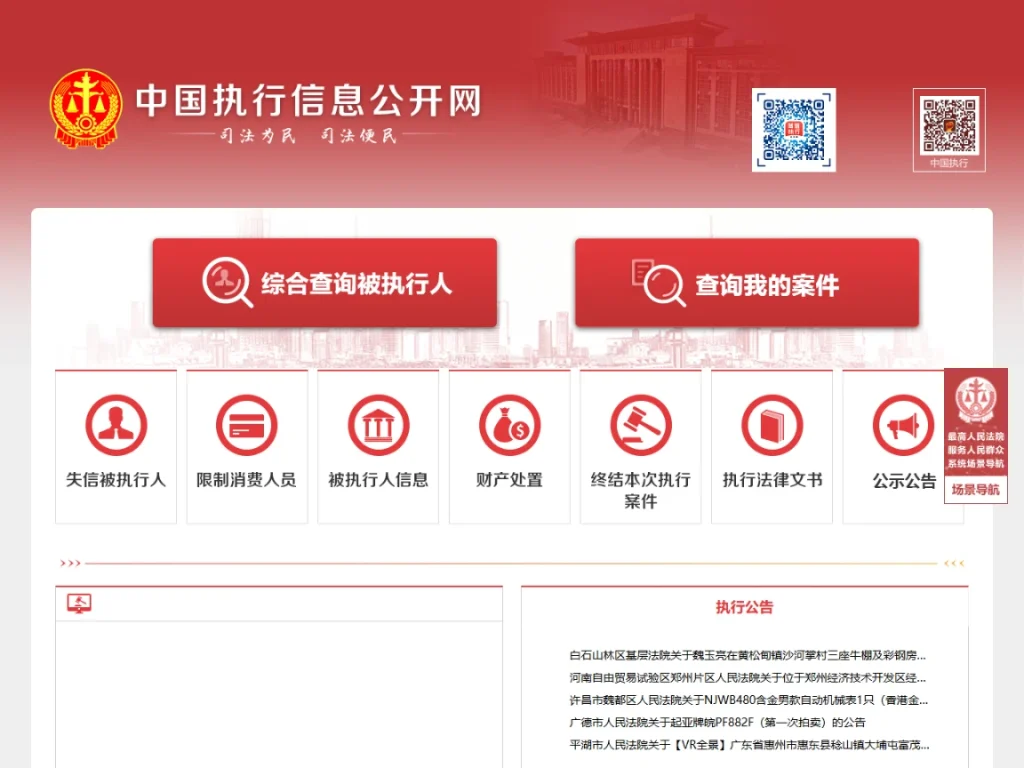
Finally, search the China Enforcement Information Publicity Network (中国执行信息公开网) at zxgk.court.gov.cn. This is the official list of people and companies the courts have ordered to pay and who haven’t settled the judgment.
Type in the company name — and also the legal representative’s name. Many buyers only search the company name, but owners and legal representatives can appear on the enforcement list personally while the business name appears clean. Searching both covers the human side of the record.
If either shows up as a “person subject to enforcement” (失信被执行人), the company is in serious financial trouble. Do not send money. A business behind on court-ordered payments is unlikely to have stable cash flow, spare production capacity, or the ability to refund a disputed order.
Step 5: Ask for an English Copy and a Real Conversation
Chinese licenses are issued in Chinese. If you can’t read Chinese, ask the supplier for a notarized English translation — or send it to us and we’ll translate it as part of your inquiry. Do not rely on a machine translation pasted into a chat window; a notarized translation preserves the exact registration details you need to compare against the public databases.
Then do the test that no document can pass: talk to them. A polished license and a fast quote cannot hide a supplier who cannot explain their own operation. Ask for the factory address, then ask again in a different way. Real factories answer the same question consistently, whether you ask about production lines, workshop location, or the production schedule. Fakes trip over their own story, giving different addresses, vague workshop descriptions, or answers that change between messages.
You can also ask practical questions that only a manufacturer can answer: what materials do you use, what is the usual order lead time, can you connect us with the person in charge of production, and what does your inspection process look like before shipment. A trading company may quote smoothly but struggles to describe the production floor, while a real factory answers with specifics. Keep a record of these answers; if the license and the conversation do not match, the conversation should be your deciding factor.
The Mistakes We See Buyers Make
After helping buyers source from the Pearl River Delta for years, we keep seeing the same verification shortcuts:
- Believing the license alone. It proves registration, not capability; that takes an on-site factory audit to confirm, whether through a visit, a video tour, or a third-party inspection report.
- Skipping the shareholder check. The company may look fine on the surface while the owner carries a history of changes, closed entities, or litigation.
- Trusting a brand-new license with a ten-year story. A young registration paired with claimed long experience is a mismatch worth exposing before any deposit.
- Falling for “Gold Supplier” badges on platforms. That badge means they paid for advertising, not that they’re verified as a factory or a reliable producer.
- Skipping final inspection. Even a real factory can ship defective goods without a pre-shipment inspection check before the containers close; verifying the company and inspecting the goods are two separate layers of protection.
What a Healthy License Looks Like vs Red Flags
To make the check easier to remember, here are the signs that usually point to a healthy, registered supplier, followed by the red flags that should slow an order down.
Against these signals, a healthy business license generally shows an active registration status, a business scope that matches the products advertised, consistent annual reports, a stable shareholder and legal representative history, no related closed entities in the past few years, and a registration date that matches the company’s claimed experience. The legal representative is not listed on the enforcement network, and the listed address matches the factory or office the supplier describes during calls.
The red flags work in the opposite direction: canceled or revoked status, missing annual reports, frequent changes of legal representative or shareholders, a chain of closed related companies, a recent name change after litigation, multiple court cases over quality or delivery, the legal representative appearing on the enforcement list, a business scope limited to trade while the supplier claims factory production, and a registration date much younger than the claimed experience.
One signal may not be enough to walk away, but several signals together mean you should verify further before paying.
The Bottom Line
Check the license. Then check the company behind it. Then check the people behind the company. Each layer answers a different question: whether the entity exists, whether it has the record and capacity to deliver, and whether the people running it carry unresolved liabilities.
Ten minutes spent checking a Chinese company’s business license can save you from losing a 30% deposit to a supplier that was never a factory at all. If you’re unsure what you’re looking at, send us the license along with the company name and registration number, and we’ll verify it for you. Every day we check licenses, factories, and public records for buyers sourcing in the Pearl River Delta, so you can spend your time on product quality and pricing rather than on paperwork.
More on factory verification
- Factory audit: the five checks — the five checks we run on every factory visit
- Lighting factory audit in Zhongshan — what a Zhongshan lighting audit actually tests
Also worth reading: AQL inspection explained — how to read the AQL tables, with a worked 1,000-unit example.