


Historias de Compras
Cómo auditamos una fábrica de difusores de aroma en Huizhou para un comprador europeo
I’m Ryan. Last month, a European buyer contacted us looking to source aroma diffusers from the Delta del Río de la Perla in China. He runs a home fragrance retail business in Europe, and he’d been sourcing products through other channels, but quality kept shifting — the same model had different mist output between batches, or the LED color was off.
What he needed wasn’t just a factory that could make diffusers. He needed one that produced the same result every time. Based on his product requirements, target price, and order volume, we screened several diffuser factories across the Delta del Río de la Perla and selected this one in Huizhou for an on-site verification. We went in ahead of him, took photos and videos, and put together a full audit report. After reviewing it and asking a few technical questions about the atomizer and noise levels on a follow-up call, he decided to fly over and see the factory himself.
This is the complete record of that aroma diffuser sourcing from China trip — and a look at how we work as your China sourcing agent.
First Stop: The Showroom
The factory is based locally in Huizhou, less than forty minutes from our office. When we arrived, the person in charge walked us straight to the showroom.
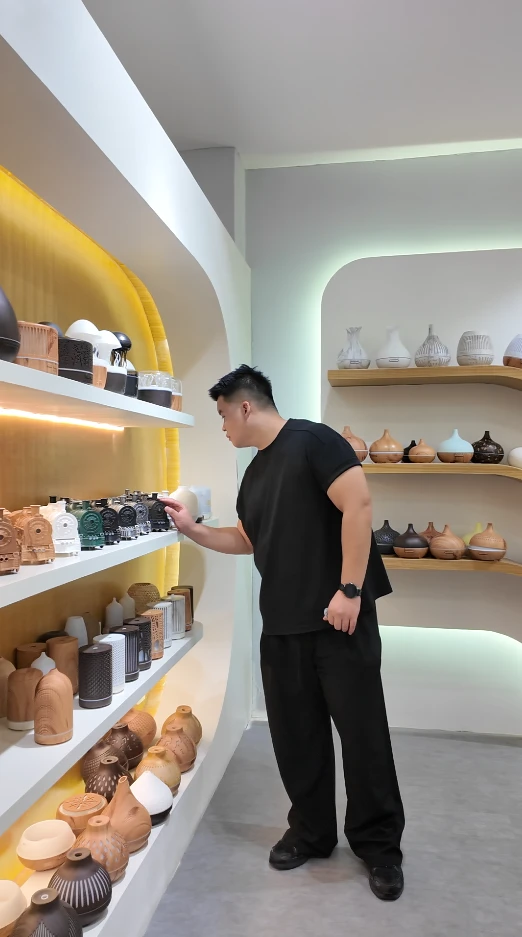
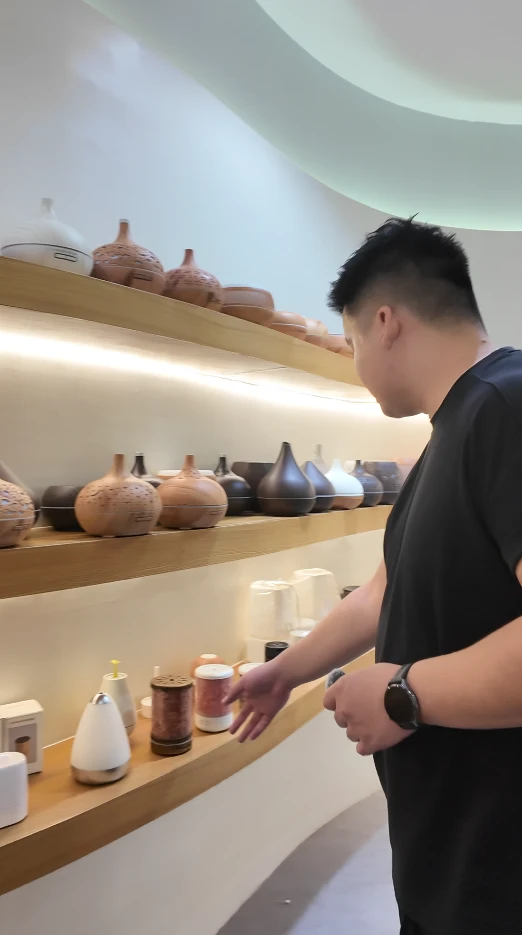
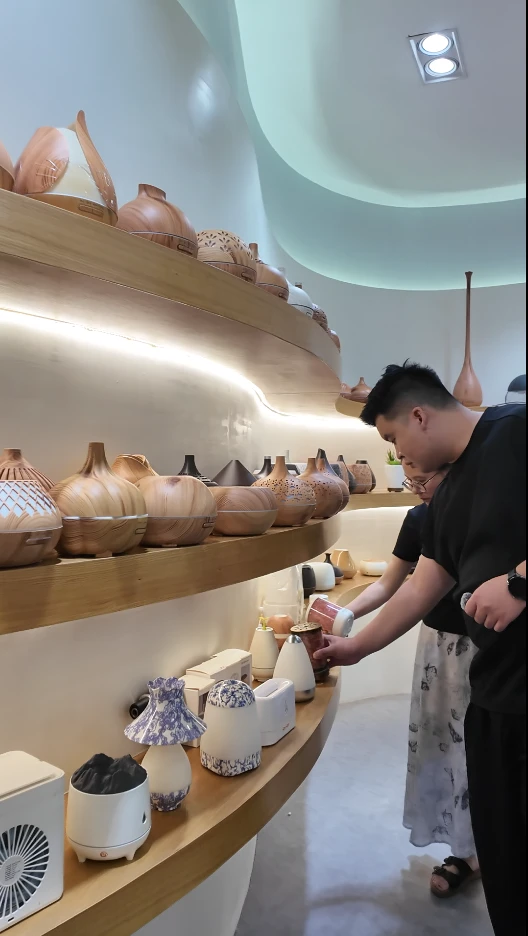
The showroom was well-designed — curved white shelving against warm yellow backlighting, with over a hundred diffusers on display. We saw droplet shapes, gourd shapes, ceramic finishes, wood-grain textures, blue-and-white porcelain styles, and even volcano designs. Colors ranged from white, black, and wood tones to blue, pink, and green.
We examined each product carefully on the client’s behalf. Picking up a wood-grain model, we felt the shell — it was ABS plastic with a wood-veneer film, not real wood, but the finish was convincing. Then we picked up a blue-and-white porcelain unit and checked the glaze — ceramic, smooth, no rough edges.
The person in charge told us, “We have over 50 existing molds in stock. Clients can pick from those, or we can open a private mold. The shell material can be ABS, ceramic, or wood-grain veneer. The atomizer uses an ultrasonic piezoelectric ceramic disc at 2.4MHz.”
This step matters a lot when you’re doing aroma diffuser sourcing from China. The showroom is the first business card of a manufacturer. A genuine aroma diffuser sourcing from China partner knows the difference between a real manufacturer and a trading company. After years of sourcing in the region, we’ve learned that an empty showroom means we can move on.
Talking Through the Details
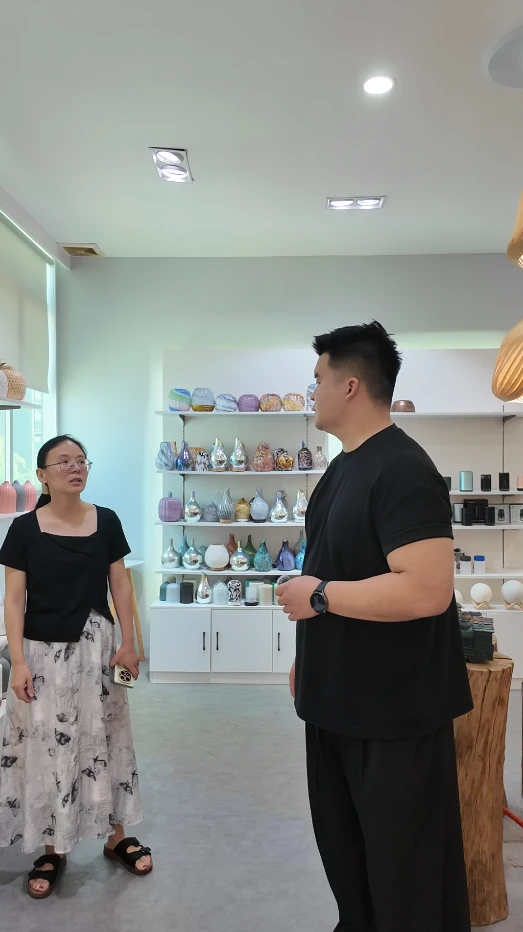
After the showroom, we sat down for a Q&A. These were the questions the client had flagged as most important:
“How long does the atomizer last?” She replied, “Under normal use, around 3,000 hours. We use a 20mm piezoelectric disc, not the cheaper 16mm type.”
“What about noise?” “Under 30 decibels — quiet enough for bedside use. We have a dedicated noise testing station, and every unit gets tested before packing.”
“Tank capacity and run time?” “Standard models are 300ml, running 4 to 6 hours on a full tank. Two mist modes, plus an intermittent setting. The LED has 7 colors — fixed or gradient.”
“Certifications?” “CE, RoHS, and FCC — all from third-party labs.”
Every answer came without hesitation. When you’re doing aroma diffuser sourcing from China, the worst sign is a factory that can’t quote its own technical specs from memory. We’ve been doing this long enough to know: if a manufacturer can’t tell you the atomizer frequency off the top of their head, bulk orders will have problems later. This person knew every model inside out — a strong positive sign.
The Aging Test Room: Rows of Glowing Diffusers
From the showroom, we headed to the aging test room before the production floor. That’s our priority on every China sourcing visit — testing first, production second.
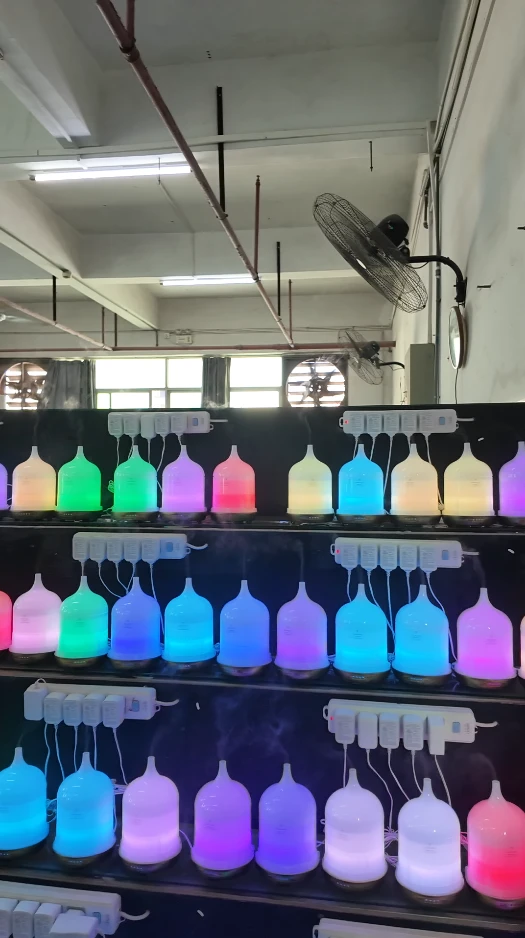
An entire shelf was lined with diffusers plugged in and running. Their LEDs glowed blue, green, purple, and pink, with fine mist rising from the tops. She explained, “These are running a 72-hour aging test. They only move to packing after they pass.”
We leaned in to check. Each unit had its own adapter, neatly routed. A logbook sat on the shelf, recording batch numbers, test duration, and defect counts. We flipped through it: the most recent batch was 2,000 units, with 8 failures — a 0.4% defect rate, mostly LED failures.
This is where quality is actually decided. Many buyers sourcing from China only walk the production floor. But the aging room, the noise test, and the insulation test are what separate a reliable factory from a risky one. After years of sourcing verification, we’ve seen factories that look great on the floor but hide dozens of defects in their test rooms. A 72-hour aging test on every batch? That’s the kind of detail that matters when you source aroma diffusers from China and can’t visit the factory yourself.
Production Floor and Packaging
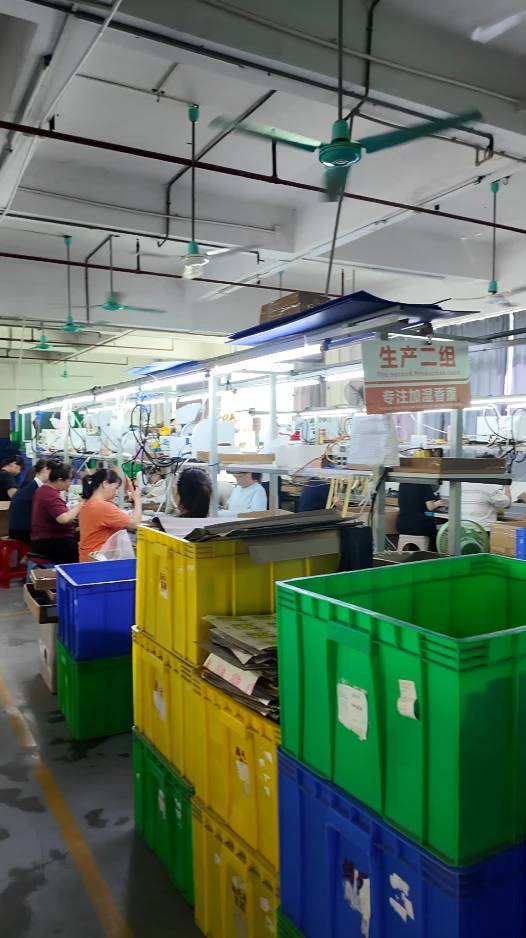
Next, the assembly line. A sign above the workstation read “Production Group 2 — Humidifiers and Aroma Diffusers.”
About a dozen workers sat at stations, each surrounded by parts: atomizers, sealing rings, water tanks, shells, circuit boards, and adapters. We watched the flow: glue the atomizer to the base, solder wires, fit the seal, insert the circuit board, close the shell, power on for a test, then pass to packaging.
The workers moved efficiently. Each unit got plugged in right after assembly — mist check, light check, noise check — before going into the good-basket.
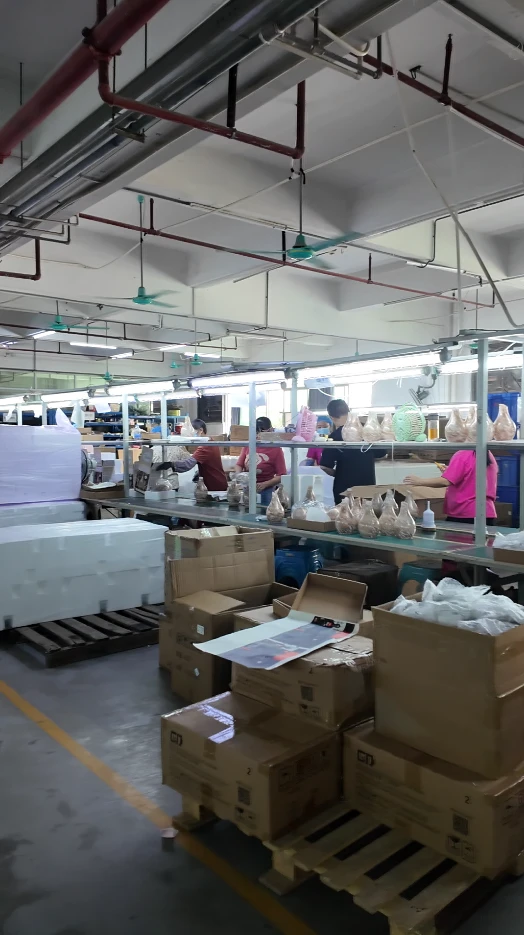
Packaging was on the other side of the floor. Workers wrapped each diffuser in a foam bag, placed it in a color box with the manual, adapter, and cleaning brush, then sealed and labeled the cartons. Pallets of finished boxes stood ready for shipment.
We paid special attention to packaging. When you’re doing aroma diffuser sourcing from China, the biggest issue often isn’t manufacturing — it’s shipping damage. This factory uses double foam bags inside a five-layer corrugated carton. We shook a box and heard no movement. That’s a standard that survives ocean freight. In sourcing, skimping on packaging is never worth the savings.
Exterior and Warehouse
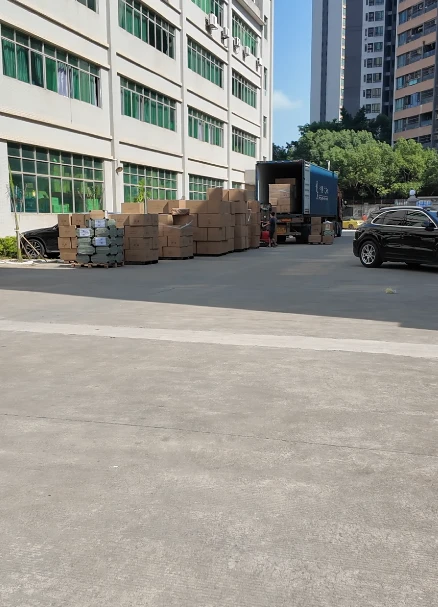
Outside, the factory was a standard industrial building. A blue truck was being loaded at the ground-floor shipping dock, with palletized cartons wrapped in stretch film.
We walked through the warehouse too. Raw materials — atomizers, circuit boards, shells, adapters — sat on labeled shelves. Finished goods were organized by customer and batch, not stacked randomly.
When sourcing from China, warehouse management tells you two things. First, are raw materials and finished goods separated? If they’re mixed up, the risk of shipping the wrong item is high. Second, can batches be traced? If there’s a quality issue, can you identify which materials caused it? This factory passed on both counts. After years of China sourcing, we’ve seen too many mixed-up warehouses — and too many wrong shipments.
More on factory audits in practice
- Evaporative cooler factory audit — a Dongguan cooler factory audit, line by line
- Wall switch factory audit — a Shenzhen switch factory audit for a US buyer
Also worth reading: Pre-shipment inspection — what we check before your balance payment leaves.
How We Screen and Verify Factories for Buyers
At this point, you might be wondering what exactly we do in a process like this.
How Our Aroma Diffuser Sourcing from China Process Works
First, based on the product category, materials, target price, and order volume, we match them with suitable factories from our Pearl River Delta network. We don’t bring buyers to every candidate — we pre-screen and eliminate the ones that clearly don’t fit. If you’re new to negotiating with suppliers, our guide on how to negotiate MOQ with Chinese factories covers the approaches that actually work.
Second, we visit the factory ahead of the buyer. Most buyers can’t fly to China to inspect every candidate. We go in, check the showroom, the test rooms, the production line, and the warehouse, and document everything with photos and video.
Third, we compile a clear report. Production capacity, quality control, testing procedures, packaging standards, and risk factors — all organized with visual evidence, so the buyer can make an informed sourcing decision without guessing.
Fourth, when the buyer flies in, we walk through the factory with them, confirming every point in the report and answering questions on the spot.
In short, the buyer makes the decisions overseas. We’re on the ground in China, seeing the factory clearly and making sure nothing is hidden. That’s the value of a dedicated China sourcing agent — not placing the order for you, but making sure you’re placing it with the right manufacturer.
Our Verdict: Is This Factory Reliable?
After walking through the entire factory, our assessment was that this factory was a strong fit for aroma diffuser production.
The strengths are clear. They focus on diffusers rather than being a generalist factory. Over 50 existing models with private-mold capability. A dedicated aging test room with 72-hour testing per batch and a 0.4% defect rate. Skilled assembly workers and consistent workflow. Ocean-grade packaging. A person in charge who knows the product well and answers questions directly.
The caveats: the factory is mid-sized, so capacity tightens during peak season (two months before Christmas), and large orders need early confirmation. While the atomizer is 2.4MHz, there can be minor batch-to-batch variation, so we recommend writing mist output and noise specs into the contract.
The client reviewed the report, had a follow-up call about custom colors and logo printing, then flew in a few days later. We walked through the factory together, confirmed everything in the report, and he decided to place a trial order of 1,000 units across three models to test product quality and delivery. Once that trial order is placed, the next step is always pre-shipment inspection — here’s how we make sure every batch meets the agreed standards before it leaves the warehouse.
Advice for Aroma Diffuser Sourcing from China Buyers
- Check the test room before the production line. Anyone can assemble units. Testing is what determines quality.
- Ask the atomizer specs. Frequency, disc size, lifespan — if they can’t answer, they’re using cheap parts.
- Inspect packaging. Ocean freight from China to Europe is unforgiving. Double foam bags and five-layer cartons are the minimum.
- Confirm certifications. CE, RoHS, and FCC — and make sure the reports are from third-party labs and still valid.
- Use someone local to pre-verify. Don’t fly to China for every candidate. Have a trusted partner screen, audit, and report first.
If you’re currently doing aroma diffuser sourcing from China or other home products, and you’d like someone on the ground in the Delta del Río de la Perla to screen factories, run audits, and send you a report — reach out. We’re based in Huizhou, and most factories we work with are within driving distance. Tell us what you need, and we’ll go take a look.