


Historias de Compras
Cómo auditamos una fábrica de enfriadores evaporativos industriales en Dongguan para un comprador australiano
I’m Ryan. A few months ago, an Australian buyer reached out to us about industrial evaporative cooler sourcing from China — a batch of industrial evaporative coolers for his warehouse and workshop in Brisbane.
His situation is pretty typical. Brisbane summers regularly hit 30 degrees and above, with extreme days pushing past 40.
His warehouse is 8 meters high and over 2,000 square meters. He had six traditional split-system air conditioners running, and his electricity bill was running AUD 7,000–8,000 a month.
On top of that, the warehouse doors are constantly opening and closing for deliveries. The AC simply couldn’t hold the temperature, and workers were sweating through their shifts in summer.
He had previously bought a batch of portable coolers from another Chinese supplier. Within a year, two units had failed fan bearings, and the cooling pads had gone moldy and smelly within three months. After-sales support was nowhere to be found.That’s when he started looking for a more reliable partner for industrial evaporative cooler sourcing from China.
He was already planning to attend the Canton Fair in Guangzhou in October, so he told us: before the fair, he’d like to visit some factories in advance. He asked us to screen a few reliable manufacturers first.
Based on his airflow requirements, coverage area, and budget, we screened several industrial cooler factories in the Pearl River Delta and selected this one in Dongguan for an on-site verification.
We went to the factory ahead of time, took photos and videos, and put together an audit record for him. After reviewing it, he confirmed the direction was right and booked his flight — fly into Shenzhen first, we take him to the Dongguan factory, then he heads to Guangzhou for the Canton Fair on his own.
This is the full audit record from this industrial evaporative cooler sourcing project— and a look at how we help buyers screen factories.
First Stop: The Showroom
The factory is in Dongguan, about an hour and a half from Shenzhen. When we arrived, the person in charge took us straight to the showroom.
The showroom is large, with seven or eight different cooler models on display.
There are portable units on casters that you can roll wherever cooling is needed. There are ducted units that connect to air ducts and deliver airflow to multiple workstations. And there are standing high-airflow units, each one capable of covering 200–300 square meters.
Housings come in either galvanized steel or stainless steel. Control panels are available in mechanical knob or smart remote versions. Detailed specs for every model are available in the factory’s product brochures.
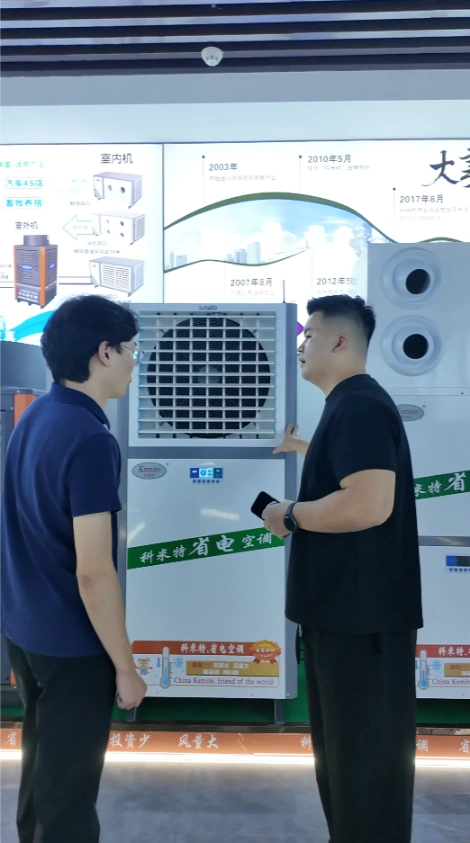
We walked over to a standing high-airflow model, and the person in charge opened the side panel to show us the internal structure.
The core component is the three-sided cooling pad — a brown, honeycomb-patterned cellulose filter that works on the principle of evaporative cooling.
Water trickles down from the top, and as air passes through, the water evaporates and absorbs heat, delivering cooler air out the front.
“The cooling pads are 5090-type cellulose paper, 5 centimeters thick,” he said. “The evaporation efficiency is higher than standard paper pads. A lot of cheaper factories use recycled paper that falls apart in a few months. Ours normally lasts two to three years.”
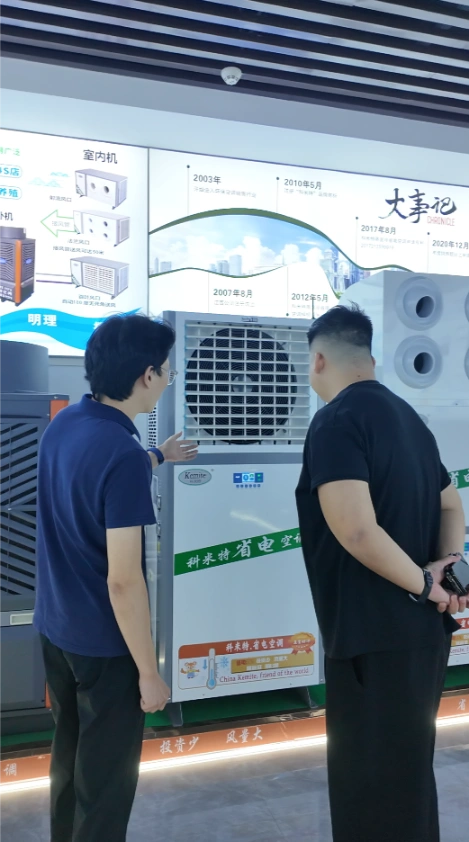
One wall of the showroom is dedicated to project case studies, with installation photos from factories, farms, shopping malls, and more.
He told us they’ve been in business for over a decade. Many large livestock farms and auto 4S dealerships in China use their equipment. For exports, they have customers in Australia, the Middle East, and Southeast Asia.For buyers doing industrial evaporative cooler sourcing from China, this kind of export track record matters — it means the factory already understands international packaging and certification requirements.
As a commercial air cooler supplier in China with over a decade of experience, they’ve built a solid track record across multiple export markets.
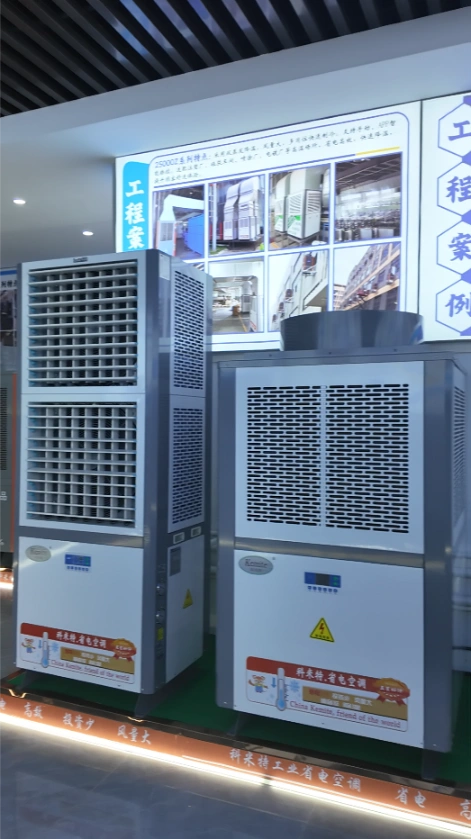
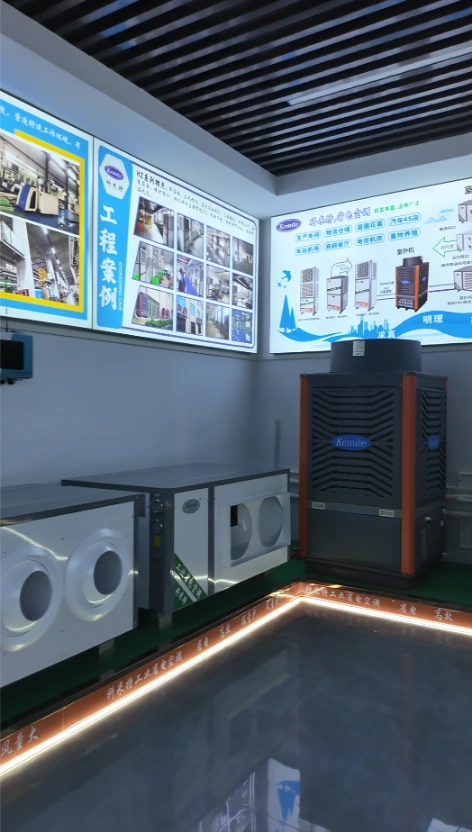
When you’re doing industrial evaporative cooler sourcing, the showroom is a factory’s first calling card.
A factory that genuinely makes industrial coolers won’t have just one or two models in the showroom — different sites need different airflow rates and delivery methods.
We’ve seen too many showrooms that look impressive but fall apart the moment you ask about airflow attenuation. This factory could clearly explain the coverage area, airflow, and power consumption for every model, and the person in charge knew the product inside out.
Talking Through the Specs
After the showroom, we sat down in the meeting room for a technical Q&A. Beyond product specs, we also asked about factory capacity and shipping realities.
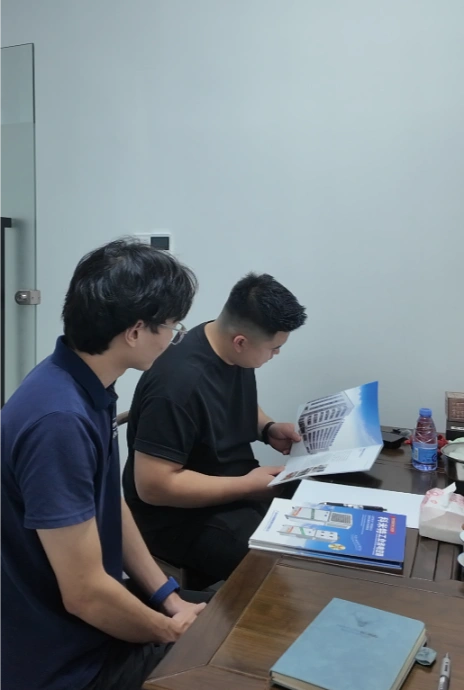
Product specs:
“This 18,000 CMH model — what’s the actual airflow?”
“The nameplate says 18,000 cubic meters per hour, measured at zero back pressure at the outlet. Once you connect ducting, there’s attenuation — roughly 15,000 CMH. We calculate back pressure for each customer and recommend the right model. We don’t inflate the numbers.”
“How much power does it use? How does it compare to traditional AC?”
“This unit is 1.1 kW. To cover the same area with traditional AC, you’d need at least a 10-horsepower system, around 7 kW. That means electricity costs are roughly one-sixth to one-eighth of traditional AC. With Australian electricity prices, that difference is significant.”
“What material are the cooling pads? How often do they need replacing?”
“5090-type cellulose paper. Under normal use, two to three years. If water quality is poor or the environment is dusty, maybe a bit over a year. Cooling pads are consumables — we always recommend customers keep spares.”
“How big is the water tank? Does it need a constant water connection?”
“60-liter tank. It can connect to a tap for automatic refill, or you can fill it manually. For industrial use, we recommend connecting to a water line so no one has to monitor it.”
“How is the housing protected against corrosion?”
“Galvanized steel as standard. For coastal or high-humidity environments, stainless steel is available. For Australian coastal locations, we recommend stainless steel — it costs more but won’t rust.”
Factory and shipping:
“How big is the factory? How many workers?”
“Over 6,000 square meters of factory space, around 40 workers. We add temporary staff during peak season.”
“What’s monthly capacity? What are lead times?”
“Roughly 1,500 units per month. For lead times — off-season is about 30 to 45 days, peak season 45 to 60 days. Because of production scheduling, we tend to give customers the more conservative estimate during busy periods to avoid missing deadlines.”
“How is packaging done? Will units survive shipping to Australia?”
“Each unit is first wrapped in bubble wrap. Cooling pads are packed separately to avoid moisture damage. Then everything goes into a five-ply corrugated carton with foam corner protectors. Pallets are stretch-wrapped. These units are bulky and get handled roughly in shipping — foam corners are non-negotiable.”
“What shipping terms do you offer? FOB Shenzhen or EXW?”
“Either, depending on what’s convenient for the customer. Most Australian buyers go with FOB Shenzhen — we handle delivery to the port.”
Every question got a direct answer. In industrial evaporative cooler sourcing, the worst sign is a factory that can’t answer its own airflow numbers or lead times.
If a factory can’t clearly explain airflow attenuation or peak-season capacity, the bulk order will almost certainly run into problems in Australia. This person in charge knew every model and every factory detail — that’s a strong positive signal.For anyone doing industrial evaporative cooler sourcing from China, this level of product knowledge is non-negotiable.
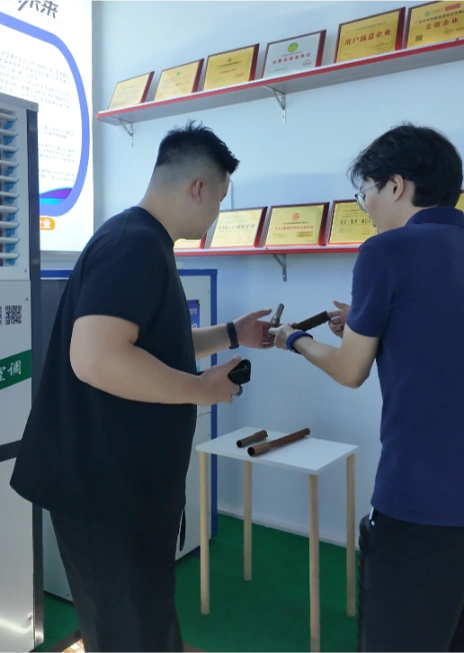
The Testing Area
From the showroom, we went to see the testing area.
The factory has a straightforward testing zone. Every large unit is powered on here after assembly — checking that the fan runs, the pump draws water, and every setting on the control panel works properly.
“Every unit gets a power-on test before it leaves the factory,” he said. “If there’s a problem, we fix it on the spot. We don’t ship defective units.”
We watched several units going through testing. Fans ran smoothly with no unusual noise, and water pump output was even.
There was an anemometer nearby. He held it up to an outlet and the reading came in at roughly 3.5 meters per second.
This step matters a lot for buyers. When you’re doing evaporative cooler quality control inspection, a lot of people only look at the production line — but the pre-shipment power-on test is the last line of defense against defective units.
We’ve seen factories with clean-looking production lines that pack units straight into boxes without any testing. Those factories tend to have much higher defect rates overseas. This one tests every unit. The equipment isn’t fancy, but the process is solid.
The key point: we don’t just take the factory’s word for it. We watch them test and check the readings ourselves.
Production Line: Cooling Pads and Assembly
Next, we visited the cooling pad storage area and the assembly line.
Cooling pads are stored in a dedicated area, stacked neatly and wrapped in plastic film to keep moisture out.
We picked up a pad and felt it — the paper was firm, the honeycomb cells were uniform, and there was no loose debris.
“Cooling pads are outsourced, but we specify 5090-type,” he said. “Every batch gets checked for thickness and density when it arrives. Anything below standard gets sent back.”
This level of cooling pad production line verification — checking every batch rather than trusting the supplier’s paperwork — is exactly what separates a reliable audit from a casual factory tour.
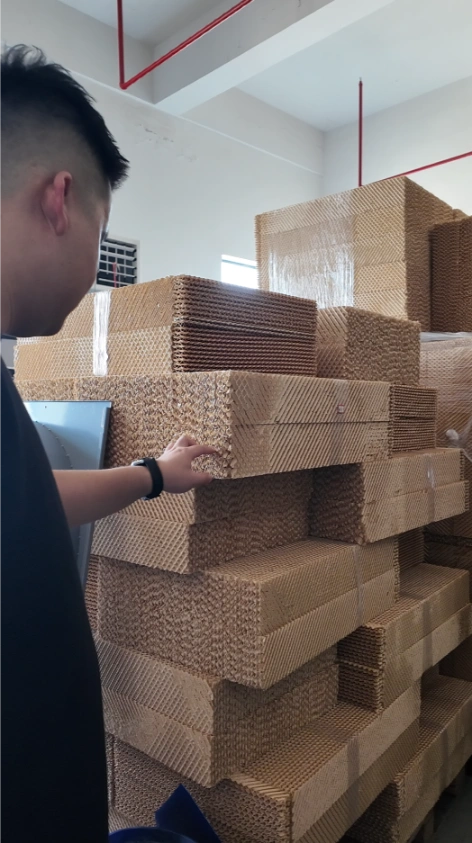
On the assembly line, workers first install the chassis and water tank, then the fan and motor, then the three-sided cooling pads, and finally the housing and control panel.
Every completed unit goes straight to the testing area for a power-on check.
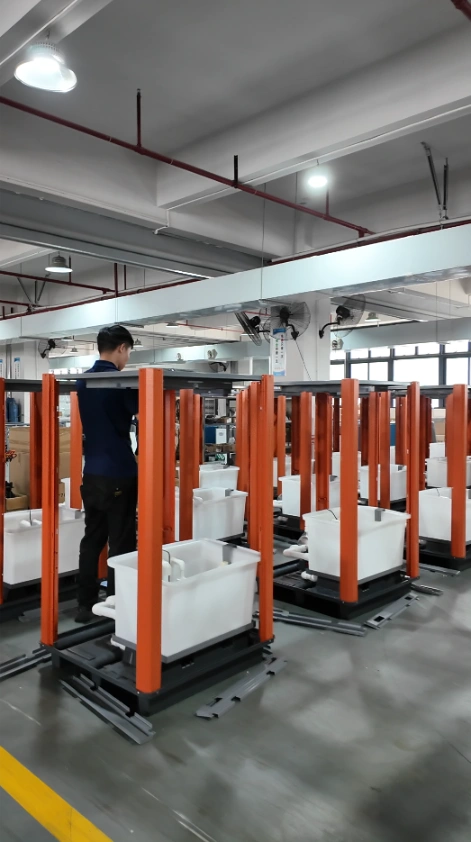
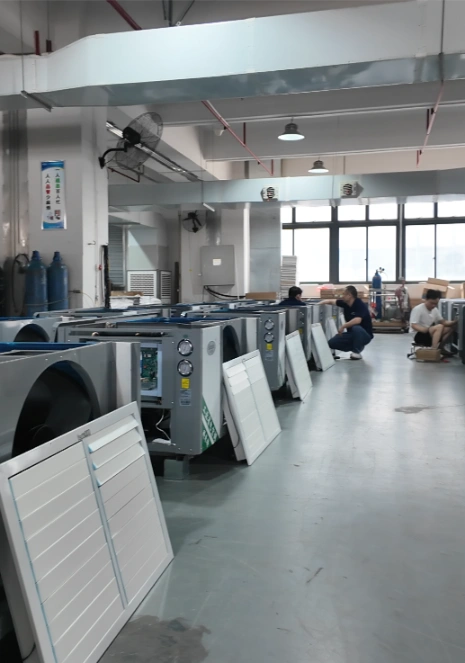
We paid special attention to the motor and water pump.
“The motor uses pure copper windings, not aluminum,” he said. “Aluminum-wound motors are cheaper but burn out easily — you can’t use them in industrial equipment. The pump is submersible with auto shutoff when water runs low, so it won’t run dry.”
When you’re sourcing from China, the motor and pump are non-negotiable checks. Roughly 70% of evaporative cooler failures come down to the motor or the pump.
Aluminum-wound motors and cheap pumps fail within six months. This factory uses pure copper motors with dry-run protection pumps — much more reliable. We check the motor nameplate and confirm winding material ourselves rather than taking the factory’s word for it.
As an industrial cooling equipment manufacturer in Dongguan, this factory’s assembly process is straightforward but disciplined — each station has a clear task, and nothing moves to the next stage until the previous one is done.
Packaging and Warehouse
Packaging happens at the other end of the assembly floor.
Each cooler is first wrapped in bubble wrap. Cooling pads are packed separately to prevent moisture damage. Then everything goes into a five-ply corrugated carton with foam corner protectors.
Finished cartons on pallets are organized by model and batch.
We shook a sealed carton — nothing shifted inside.
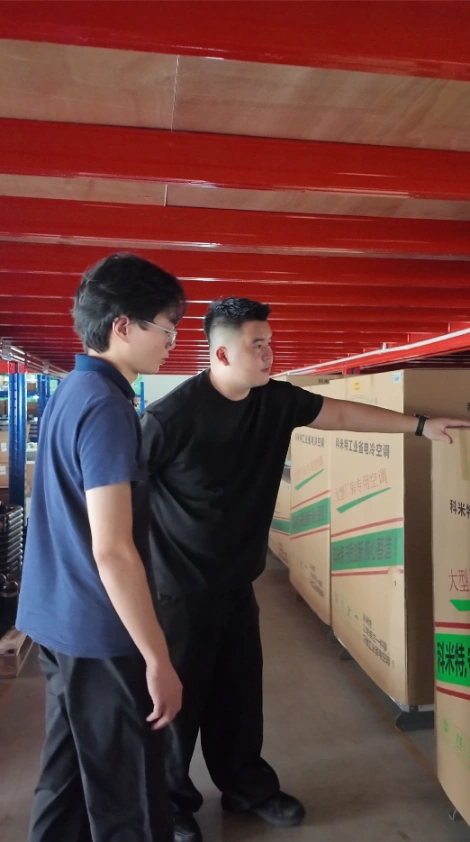
In the warehouse, raw materials — motors, pumps, cooling pads, galvanized steel — sit on labeled shelves. Finished goods are separated by model and batch, not piled together randomly.
When you’re doing industrial evaporative cooler sourcing from China, the warehouse tells you two things.
First, are raw materials and finished goods separated? If they’re mixed together, the risk of shipping the wrong order goes up significantly.
Second, are cooling pads stored in dry conditions? If pads absorb moisture and grow mold, the unit will blow smelly air once it’s installed. This factory passes both checks.
More on factory audits in practice
- Wall switch factory audit — a Shenzhen switch factory audit for a US buyer
- Aroma diffuser factory audit — a real Huizhou factory audit, room by room
Also worth reading: During production inspection — catching defects at 30%, 50% and 80% through the run.
How We Screen and Verify Factories for Buyers
At this point, you might be wondering how exactly we work.
When you work with us on sourcing, it starts the moment you tell us what you need:
First, we match you with suitable factories from our Pearl River Delta network based on product category, airflow requirements, coverage area, and budget. We don’t take you to every candidate — we screen first and eliminate the ones that clearly don’t fit.
If you’re just starting negotiations with suppliers, our MOQ negotiation guide has some practical, field-tested approaches.
Second, we visit the factory ahead of time for verification. Most buyers can’t fly to China to inspect every candidate factory. We go in — showroom, testing area, production line, warehouse — and document everything with photos and video.
Third, we put together a clear record. Production capacity, quality control, testing process, packaging standards, risk points — all backed by photo evidence, so you can make a decision without guessing.
Fourth, when you arrive in China, we walk the factory with you, confirming every item in the record and answering questions on the spot.
For buyers who are already planning a trip to China for a trade show, we recommend scheduling factory visits before the event — it’s a more efficient use of your time, and you can compare what you see at the factory with what you find on the show floor.
Simply put: you make decisions from overseas, we see everything on the ground in China, and nothing gets hidden.
That’s the value of a Pearl River Delta sourcing partner — not placing orders for you, but making sure the factory you order from is the right one.
Our Verdict: Is This Factory Reliable?
After walking through the entire factory, our assessment for this industrial evaporative cooler sourcing project is: this factory is suitable for cooperation.
The strengths are clear. They focus on industrial coolers — not a jack-of-all-trades factory. Multiple models cover different use cases. Every unit gets a pre-shipment power-on test. Cooling pads are specified as 5090-type and checked per batch. Pure copper motors with dry-run protection pumps.
The assembly line has a clear process. Shipping-grade packaging. The person in charge knows the product and answers directly.For industrial evaporative cooler sourcing from China, these are the factors that separate a reliable long-term partner from a one-time supplier.
There are also points to watch.
The factory is mid-sized. During peak season (June–October, before Australian summer), capacity gets tight, so large orders need lead-time confirmation in advance.
Cooling pads are outsourced. Even though the type is specified, we recommend writing the cooling pad brand and model into the contract to prevent batch-to-batch inconsistency.
Coastal customers must choose stainless steel housings. Galvanized steel can rust within a year or two in Australia’s coastal salt-air environment.
After reviewing our audit record, the buyer followed up with questions about custom logo printing and the stainless steel upcharge, then flew over as planned.
We walked the factory together, confirmed everything in the record, and he decided to place a 50-unit trial order — three models, one batch each — to test cooling performance and durability.
After a trial order, the next step is always pre-shipment inspection — that’s how we make sure every batch meets the agreed standard before it leaves the warehouse.
Advice for Industrial Evaporative Cooler Sourcing from China Buyers
- Check testing before the production line. Anyone can assemble a unit — the pre-shipment power-on test is what determines quality.
- Ask about cooling pad type and lifespan. 5090-type or standard paper? How often does it need replacing? If they can’t answer, they’re using cheap pads.
- Verify motor material. Pure copper or aluminum? Aluminum-wound motors are cheaper but burn out easily — unacceptable for industrial use.
- Inspect packaging. Coolers are bulky and shipping is rough. Foam corner protectors + five-ply corrugated cartons are the baseline.
- Choose stainless steel for coastal environments. Galvanized steel rusts in coastal salt air — don’t skimp here.
- Order early in peak season. Australian buyers stock up before summer. June–October is factory peak season, and lead times stretch to 45–60 days.
- Have someone on the ground verify first. Don’t fly to China for every candidate factory — have a reliable partner screen, audit, and document first.
If you’re doing industrial evaporative cooler sourcing from China or sourcing other industrial cooling equipment, and you need someone on the ground in the Pearl River Delta to screen factories, conduct audits, and put together records — get in touch.
We’re based in Huizhou, and most of our partner factories are within driving distance. Tell us what product you need, and we’ll start with factory screening and on-site verification.
If you’d like to see how we run on-site audits and factory screening for your own product, schedule a free call with our team and we will explain what our verification process covers.