


Historias de Compras
Cómo auditamos una fábrica de interruptores de pared en Shenzhen para un comprador estadounidense
I’m Ryan. Last month, a US building-materials buyer reached out to us about wall switch socket sourcing from China — specifically a batch of US-standard wall switches and socket outlets. He runs a residential and commercial construction supply business in the States, and he’d been through several suppliers already, but quality kept shifting.
Same model, different copper thickness from one batch to the next. Some sockets developed loose contacts after six months — plugs wouldn’t stay in. A few shipments of smart switches had Wi-Fi modules that kept dropping connection. What he needed wasn’t a cheaper supplier. It was a factory that shipped the same quality every single time.
Based on his product specs, target price, and order volume, we screened several switch and socket factories across the Pearl River Delta and selected this one in Shenzhen for our on-site wall switch factory audit. We went in ahead of him, took photos and video, and put together a full audit report. After reviewing it and following up with a few technical questions about copper thickness, temperature-rise testing, and UL certification, he decided to fly over and see the factory himself.
This is the complete record of that wall switch socket sourcing from China audit — and a look at how we help buyers screen factories.
First Stop: The Showroom
The factory is in Shenzhen, about an hour and a half from our office. When we arrived, the person in charge walked us straight to the showroom.
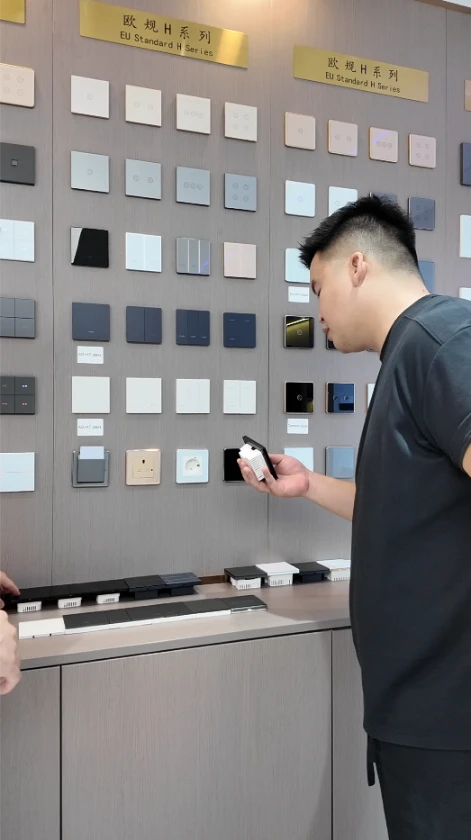
The showroom was large — an entire wall covered with switches and socket panels. US Standard H Series and S Series, lined up neatly. There were traditional toggle switches, push-button switches, and smart touch switches with LED indicator lights. Colors ranged from white, black, and gray to gold and brushed silver. Sockets included standard duplex receptacles, fast-charge models with USB-A and Type-C ports, and combination panels with switch control.
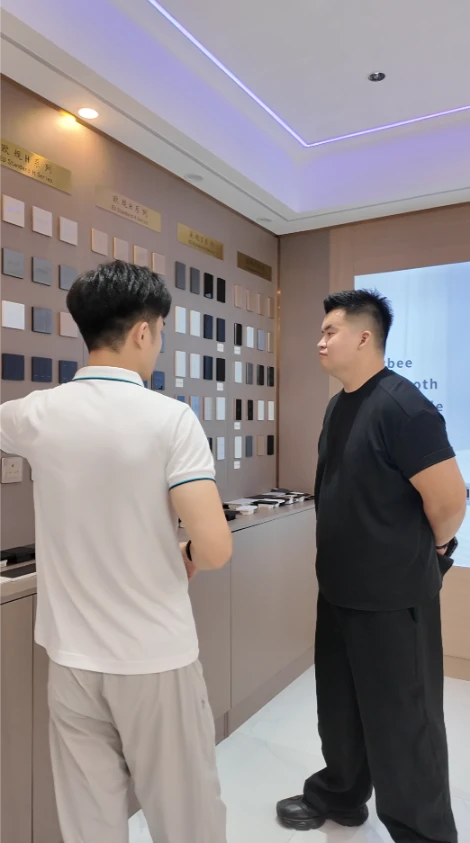
We examined each product carefully. Picking up a white panel, we felt the surface — PC material, matte finish, no burrs. Then we picked up a black tempered-glass smart switch and checked the touch surface — smooth, with chamfered edges. The person in charge told us, “We have over 80 existing molds in stock. Clients can pick from those, or we can open a private mold. Panel materials come in PC, tempered glass, and brushed metal. The copper parts are 0.6mm tin-phosphor bronze, not cheap brass. The contacts are silver alloy — not pure silver, and not copper with silver plating.”
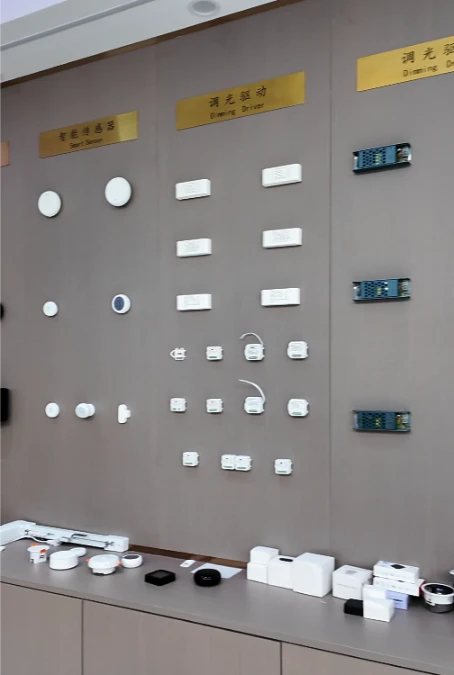
Another wall in the showroom displayed smart sensors and dimming drivers, plus a gateway series. Various motion sensors, door/window sensors, temperature-humidity sensors, and dimming drivers in different wattages. The person in charge said, “Smart switches aren’t just about the panel. The gateway and sensor ecosystem behind them has to be complete. A lot of buyers auditing smart switch factories in China only look at the panel and ignore gateway compatibility — then the bulk order arrives and nothing connects.”
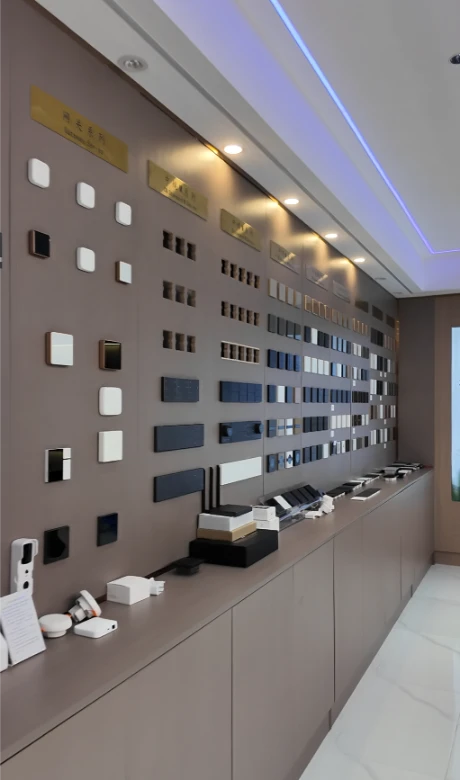
This matters a lot for anyone doing a wall switch factory audit in China. The showroom is a manufacturer’s first business card. A genuine switch-and-socket factory doesn’t have an empty sample room — and every series needs the corresponding certification documents on hand. We’ve seen too many showrooms that look great but can’t produce a single UL certificate when asked. This factory was different — every series had a UL file number and test report copies posted right next to it. For a US standard socket manufacturer in Shenzhen, UL certification is a hard threshold. No UL, no shortlist.
Talking Through the Specs
After the showroom, we sat down in the meeting room for a Q&A. These were the questions the buyer had flagged as most important:
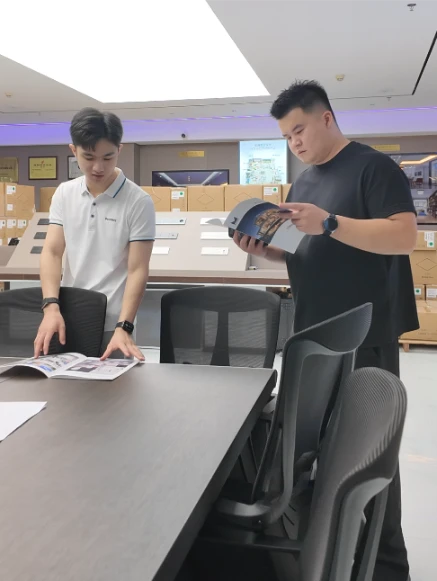
“How thick is the copper?” She replied, “Socket copper parts are 0.6mm tin-phosphor bronze. Switch contacts are 3mm silver alloy. Tin-phosphor bronze has better elasticity than brass — it won’t come loose after 5,000 insertions.”
“What about temperature-rise testing?” “We have a dedicated temperature-rise test bench. Full-load power for 4 hours, measuring terminal temperature rise. The US standard requires no more than 30K. We keep it under 25K.”
“Insulation resistance and dielectric strength?” “Insulation resistance is over 100MΩ at 500V DC. Dielectric strength is 2,000V AC for one minute without breakdown. We sample-test every batch.”
“Mechanical lifespan?” “Switches: 40,000 operations. Sockets: 5,000 insertions. We have mechanical-life test machines running 24/7.”
“Which models are UL certified?” “Both the H Series and S Series have UL 20 certification. The smart switches have FCC. You can look up the file numbers on the UL website. When you’re looking for a UL certified switch supplier in China, always verify the file number — don’t just take a photocopy.”
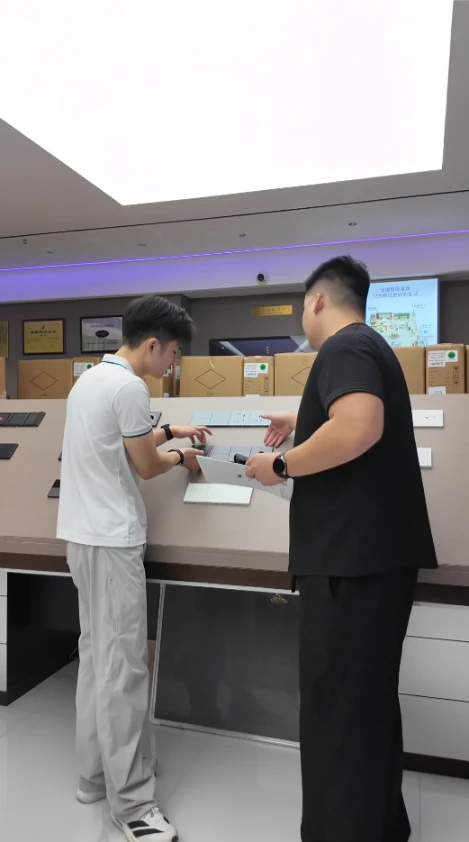
Every answer came without hesitation, and she could pull the corresponding test report for each one. When you’re comparing switch and socket factories in China, the worst sign is a factory that can’t quote its own technical specs from memory. If a manufacturer can’t tell you the copper thickness or temperature-rise standard off the top of their head, bulk orders will have problems later. This person knew every model inside out — a strong positive sign.
The Testing Lab: Where Safety Is Decided
From the showroom, we headed to the testing lab before the production floor. That’s our priority on every factory audit — testing first, production second.
Four or five pieces of equipment were running in the lab. On the temperature-rise test bench, a row of sockets was under full load, with thermocouples attached to the terminals feeding real-time data to a computer. The person in charge pointed at the screen: “This batch has been running for 3 hours. Terminal rise is 22K — no issues.”
Next to it, a mechanical-life test machine was cycling dozens of switches simultaneously. The counter read 32,000 operations. We asked to see the test log — factories don’t usually volunteer this kind of data, so we always ask. Flipping through it, we found that the most recent 40,000-cycle batch had 2 switches fail at 38,000 cycles — a 0.5% defect rate. We asked what caused it.
The factory explained that the contact-soldering temperature had been too high on that batch, and they’d already adjusted the process parameters. We noted it in the report as a resolved issue, but also flagged it for the buyer’s awareness.
There was also an insulation-resistance tester, a dielectric-strength tester, and an oxidation test station for copper parts. The person in charge said, “Copper parts and metal panels all go through anti-oxidation treatment, so they don’t corrode when installed in humid environments.” We verified this by checking the treatment records — not just taking their word for it.
This is where quality is actually decided. Many buyers who run electrical switch quality control only walk the production floor. But the testing lab — temperature-rise, insulation, dielectric — is what separates a reliable factory from a risky one. We’ve seen factories with spotless production lines but a testing room that consists of a single multimeter. This one had complete equipment and records, and the 40,000-cycle mechanical test was genuinely running, not just for show. The key is: we don’t just listen to what the factory tells us. We ask to see the logs, we read the numbers, and we verify against the standards. A factory can say anything — the test records are what tell the truth.
This is the level of detail we bring to every wall switch factory audit in China — not just a factory tour, but a real verification.
Injection Molding and Assembly Line
Next, the injection-molding workshop and assembly line.
The injection-molding workshop had over a dozen machines running PC panels. We checked the molds and the finished parts — smooth surfaces, no sink marks, no flash, no color variation. The person in charge said, “We use V0 flame-retardant PC, not regular PC. Switches and sockets are electrical products. Flame retardancy is the bottom line.”
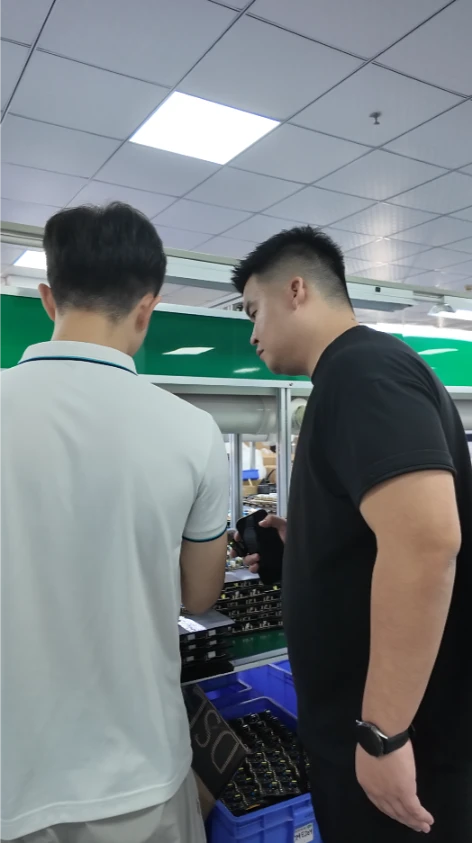
On the assembly line, about 20 workers sat at stations: copper stamping, contact soldering, base assembly, panel fitting, power-on testing, then packaging. Every unit got plugged in right after assembly — on/off test, LED test, touch-sensitivity test — before going into the good-basket.
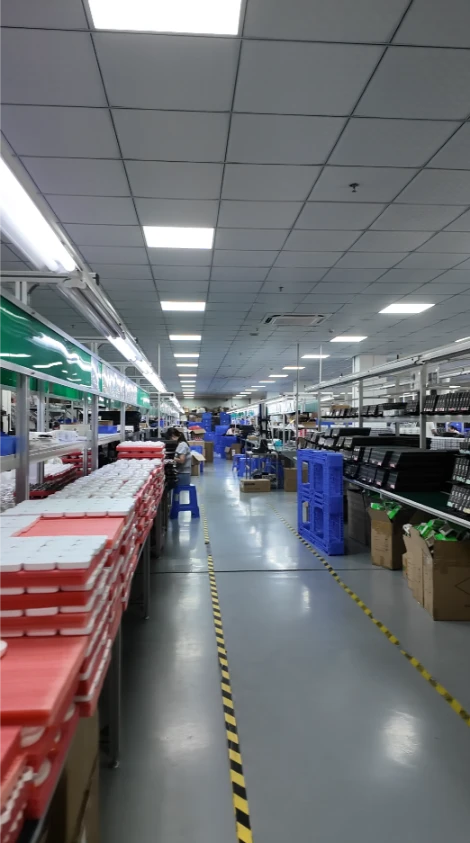
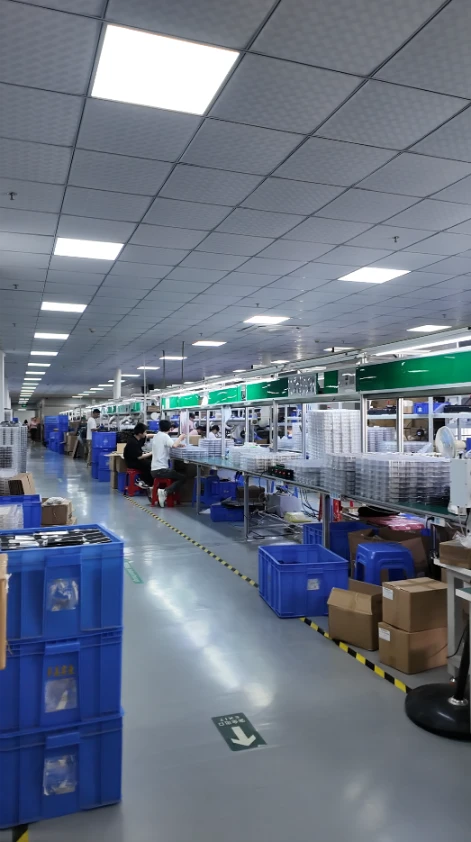
We paid special attention to the copper-stamping area. A tin-phosphor bronze strip went through the stamping machine and came out as uniformly shaped copper parts. We pulled a few finished parts and measured the thickness with calipers ourselves — confirmed at 0.6mm, matching what the factory had told us. This is the kind of thing you can’t just take on faith.
The person in charge said, “We stamp our own copper parts. We don’t outsource them. That way we control thickness and elasticity.” A lot of small factories buy copper parts from outside, and the thickness varies from batch to batch — then the bulk order quality is inconsistent. We’ve seen it happen, which is why we always measure.
When verifying a wall socket production line, copper parts and contacts are non-negotiable checks. Seventy percent of a switch or socket’s quality comes down to the copper and the contacts. Thin copper, bad contacts — it doesn’t matter how good the panel looks. This factory stamps its own copper and solders its own contacts, which gives them much tighter quality control.
Packaging and Warehouse
For US standard wall switch orders from China, packaging is where a lot of factories cut corners. Packaging was on the other side of the floor. Each switch was wrapped in a foam bag, placed in a color box with a manual and mounting screws, then sealed and labeled. Pallets of finished boxes stood organized by customer and batch.
We shook a sealed carton — no movement inside. The person in charge said, “The color boxes are five-layer corrugated. The inner tray is a blister tray, not molded pulp. Ocean freight to the US is rough. The panels can’t get scratched.”
In the warehouse, raw materials — PC resin, copper strip, silver contacts, PCB boards — sat on labeled shelves. Finished goods were organized by customer and batch, not stacked randomly.
When you join a wall switch factory audit in China, the warehouse tells you two things. First, are raw materials and finished goods separated? If they’re mixed up, the risk of shipping the wrong item is high. Second, can batches be traced? If there’s a quality issue, can you identify which materials caused it? This factory passed on both counts.
More on factory audits in practice
- Aroma diffuser factory audit — a real Huizhou factory audit, room by room
- Evaporative cooler factory audit — a Dongguan cooler factory audit, line by line
Also worth reading: AQL inspection explained — how to read the AQL tables, with a worked 1,000-unit example.
How We Run a Wall Switch Factory Audit in China
At this point, you might be wondering what we actually do during a wall switch factory audit in China.
Our process starts the moment a buyer tells us what they need:
First, based on the product category, materials, target price, and order volume, we match them with suitable factories from our Pearl River Delta network. We don’t bring buyers to every candidate — we pre-screen and eliminate the ones that clearly don’t fit. If you’re new to negotiating with suppliers, our guide on how to negotiate MOQ with Chinese factories covers the approaches that actually work.
Second, we conduct the wall switch factory audit ahead of the buyer. Most buyers can’t fly to China to inspect every candidate. We go in, check the showroom, the test rooms, the production line, and the warehouse, and document everything with photos and video.
Third, we compile a clear report. Production capacity, quality control, testing procedures, packaging standards, and risk factors — all organized with visual evidence, so the buyer can make an informed decision without guessing.
Fourth, when the buyer flies in, we walk through the factory with them, confirming every point in the report and answering questions on the spot.
In short, the buyer makes the decisions overseas. We’re on the ground in China, seeing the factory clearly and making sure nothing is hidden. That’s the value of a dedicated Pearl River Delta sourcing partner — not placing the order for you, but making sure you’re placing it with the right manufacturer.
Our Verdict: Is This Factory Reliable?
After walking through the entire factory, our assessment for this wall switch socket sourcing from China project was: this wall switch factory audit matched the buyer’s requirements.
For this Shenzhen wall switch factory audit, the strengths are clear. They focus on switches and sockets rather than being a generalist factory. Over 80 existing models with private-mold capability. A dedicated testing lab with temperature-rise, insulation, dielectric, and mechanical-life equipment — all with records. They stamp their own copper parts at 0.6mm tin-phosphor bronze with silver-alloy contacts. Every unit gets a power-on test on the assembly line. Ocean-grade packaging. A person in charge who knows the product well and answers questions directly.
The caveats: the factory is mid-sized, so capacity tightens during peak season (two months before Black Friday and Christmas), and large orders need early confirmation. The Wi-Fi modules in the smart switches are outsourced — although they have FCC certification, we recommend writing the module brand and firmware version into the contract to avoid batch-to-batch inconsistency.
The client reviewed the report, had a follow-up call about custom logos and packaging details, then flew in a few days later. We walked through the factory together, confirmed everything in the report, and he decided to place a trial order of 1,000 units across three models to test product quality and delivery. Once that trial order is placed, the next step is always pre-shipment inspection — here’s how we make sure every batch meets the agreed standards before it leaves the warehouse.
Advice for Buyers Sourcing Wall Switches from China
- Check the test room before the production line. Anyone can assemble units. Testing is what determines quality.
- Ask the copper and contact specs. Thickness, material, lifespan — if they can’t answer, they’re using cheap parts.
- Verify UL certification. Get the UL file number and look it up on the UL website. Don’t settle for a photocopy.
- Inspect the packaging. Ocean freight from China to the US is unforgiving. Double foam bags and five-layer cartons are the minimum.
- Use someone local to pre-verify. Don’t fly to China for every candidate. Have a trusted partner screen, audit, and report first.
If you’re currently doing wall switch socket sourcing from China or other electrical products, and you’d like someone on the ground in the Pearl River Delta to screen factories, run audits, and send you a report — reach out. We’re based in Huizhou, and most factories we work with are within driving distance. Tell us what product you’re sourcing, and we’ll start with a factory shortlist and on-site audit. If you’d like to learn how we screen and audit electrical factories on the ground, speak to our team about a free consultation and we will explain our verification step by step.